

It is the question every FSc pre-medical student asks, usually late at night: is MDCAT really that difficult? Friends say it is impossible, seniors tell scary stories, and social media is full of 180/180 toppers. Here is an honest answer, without the fear and without false comfort.
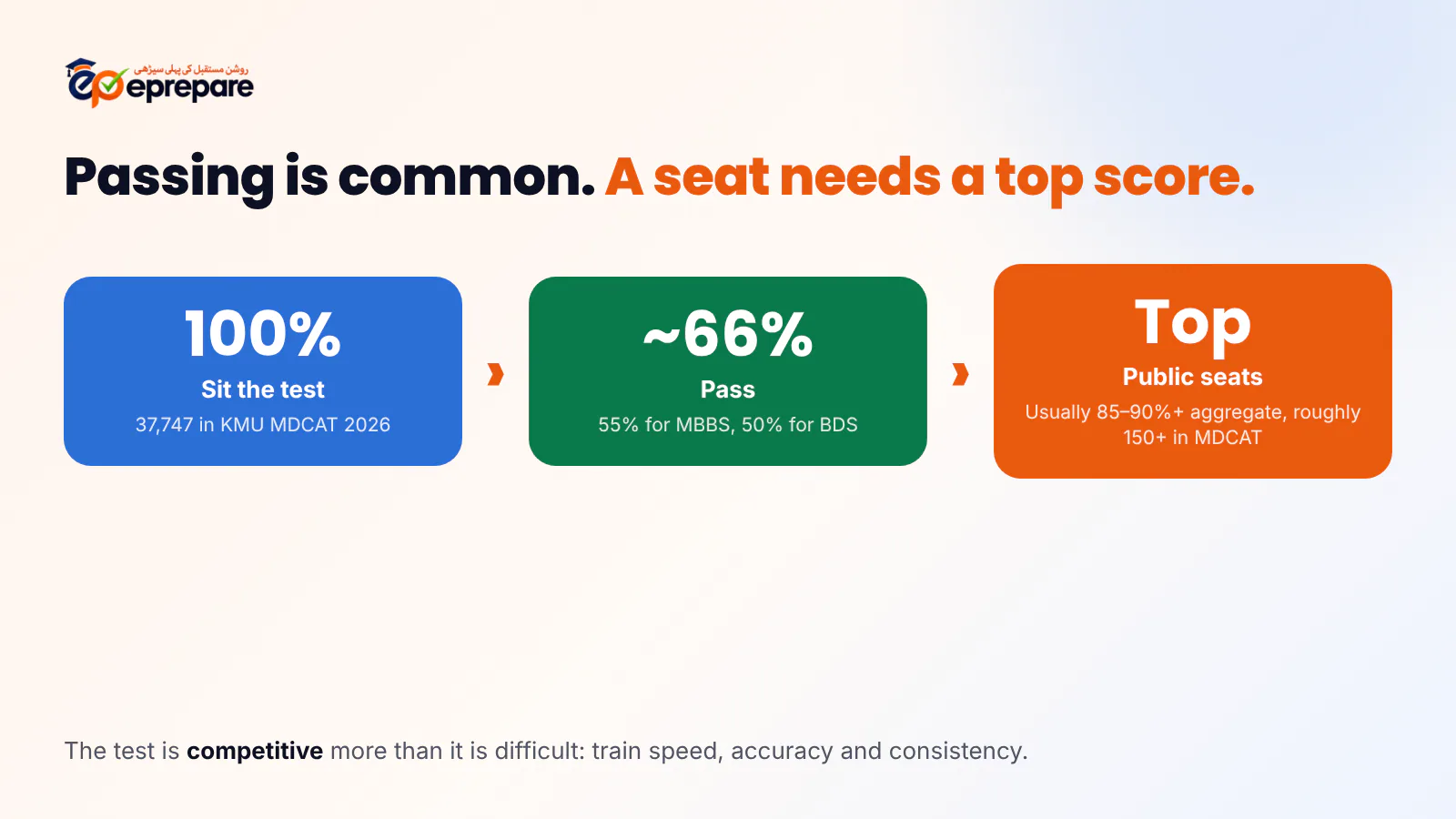
The short answer: Passing the MDCAT is very achievable: in the 2026 KMU MDCAT about two out of three candidates passed. What is difficult is scoring high enough for a public medical college, because thousands of well-prepared students compete for a limited number of seats. The questions themselves come from your FSc textbooks; the challenge is speed, accuracy and consistent preparation, and all three can be trained.
What the numbers say
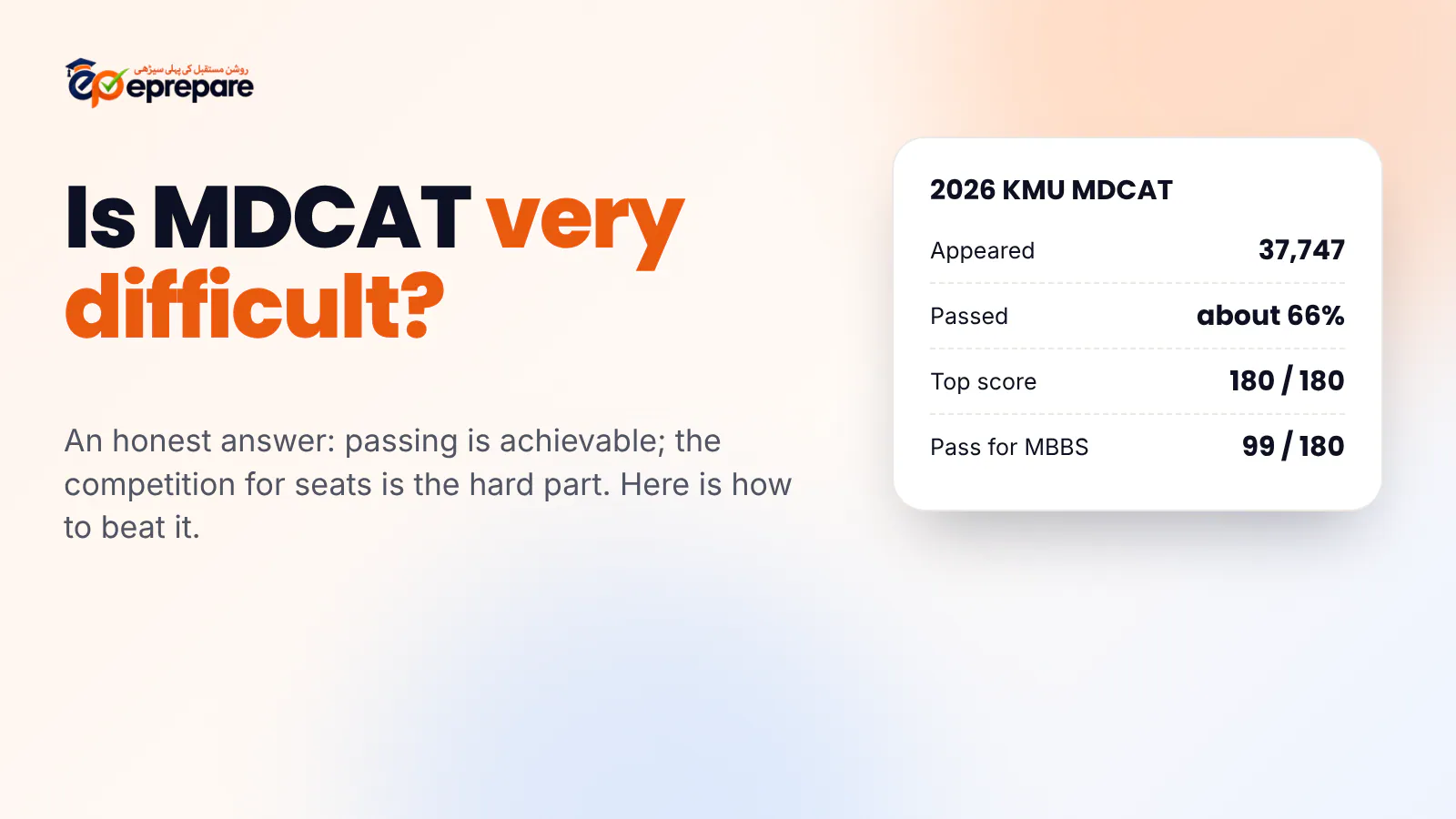
In the 2026 KMU MDCAT (Khyber Pakhtunkhwa), 37,747 candidates appeared and about 66% passed, and the top score was a perfect 180/180. So the paper is passable for most prepared students, and fully solvable for the best ones. The real filter is not the pass mark but the merit list.
| Goal | What you need | Difficulty |
|---|---|---|
| Pass MDCAT for MBBS | 55%, i.e. 99/180 | Achievable with steady preparation |
| Pass MDCAT for BDS | 50%, i.e. 90/180 | Achievable with steady preparation |
| Private medical college | A passing score, plus merit for the college you choose | Moderate |
| Public medical college | Usually an aggregate above 85 to 90%, which needs roughly 150+ in MDCAT | Hard: this is where the competition is |
See exactly what each college closed at on the KMU closing merit and MDCAT closing merit pages, and check your own number with the aggregate calculator.
What actually makes MDCAT hard
1. Competition, not the questions
Every year far more students pass than there are public seats. Because merit is decided to decimals, a difference of two or three MCQs can move you hundreds of places. The test is competitive more than it is difficult.
2. Speed
180 MCQs in 3 hours is one minute per question, including Physics numericals without a calculator. Students who know the answer but are slow lose marks they deserved.
3. Depth of textbook knowledge
Many MCQs test a single line of the FSc book: a name, a number, an exception. Students who studied only from short notes find these "tricky", when they are simply from the text.
4. Biology's weight
Biology is 81 of 180 MCQs (45%). A weak Biology preparation cannot be rescued by the other subjects.
5. Pressure and FSc overlap
Preparation runs alongside FSc board exams, and the test is a one-day event that decides a career. Managing stress is part of the job.
What does not make it hard
- The syllabus is fixed and known. PM&DC publishes it; nothing comes from outside FSc level.
- There is no negative marking. Guessing a question you cannot solve costs nothing.
- The pattern repeats. Past papers show the same chapters and question styles year after year.
- English and Logical Reasoning are short. 18 MCQs together, and very scoreable with practice.
Which subject is the hardest?
| Subject | MCQs | Why students find it hard | What works |
|---|---|---|---|
| Biology | 81 | Volume: many facts and lines to remember | Line-by-line reading plus daily Bookline MCQs |
| Chemistry | 45 | Organic reactions and exceptions | Charts of reactions, frequent revision |
| Physics | 36 | Numericals under time pressure | Formula sheets, timed numerical practice |
| English | 9 | Tricky grammar rules | Ten grammar MCQs a day |
| Logical Reasoning | 9 | Unfamiliar question types | Learn the patterns once, then practise |
Most students rate Physics the hardest, but Biology decides most results because of its weight. Start with our high-yield chapter lists for Biology, Chemistry and Physics.
How to make MDCAT easier: a practical plan
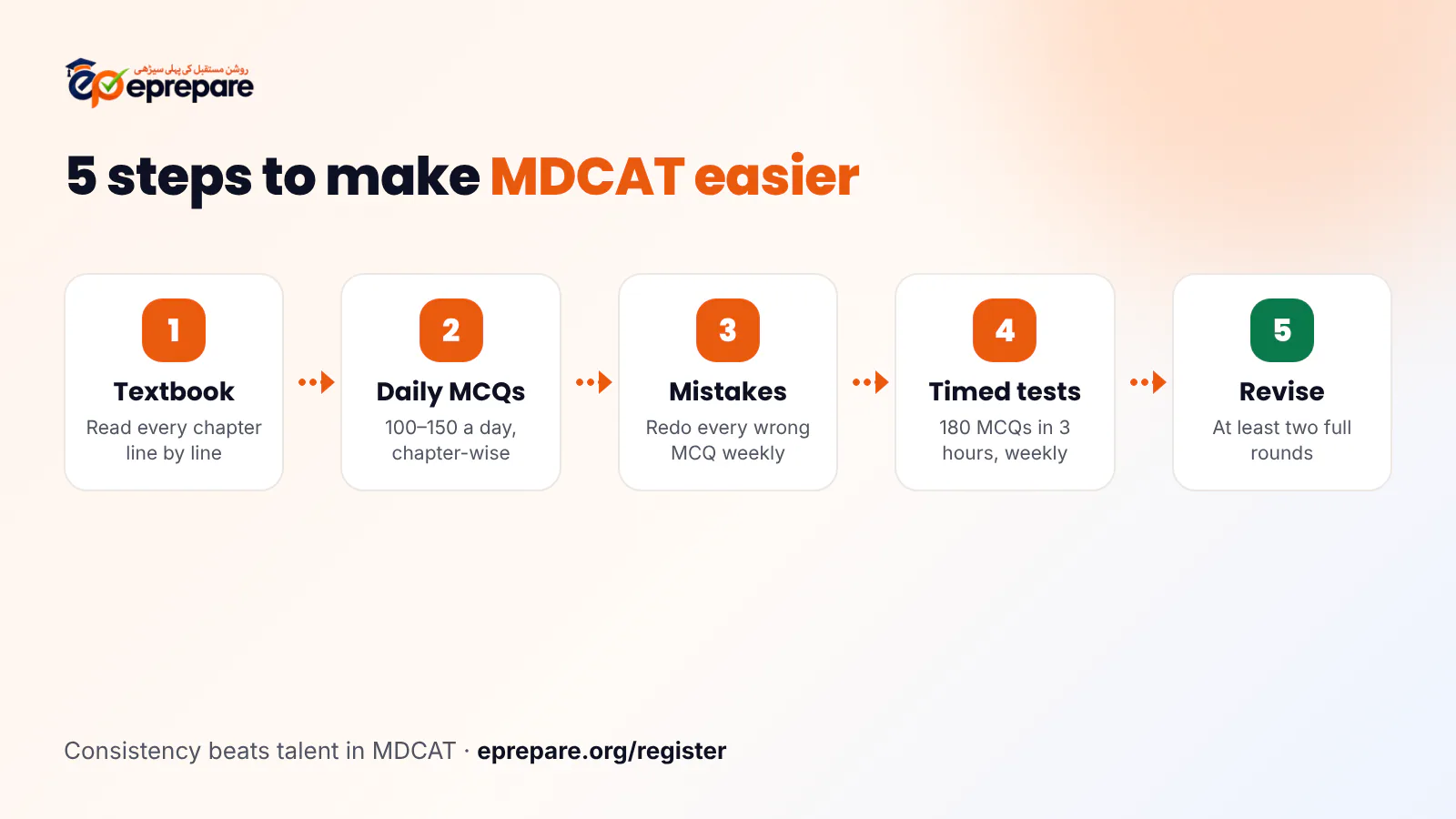
- Read the textbook, not only notes. One complete reading of every chapter removes most "tricky" MCQs.
- Do MCQs every day. Aim for 100 to 150 a day in the main preparation months.
- Review every mistake. Keep a list of wrong MCQs and redo them weekly; most marks are won here.
- Train your speed. From two months before the test, take full 180-MCQ papers in 3 hours every week. See MDCAT mock tests and FLPs.
- Solve past papers. They show what is asked and how. Start with MDCAT past papers.
- Revise at least twice. A chapter read once is forgotten by test day.
- Look after yourself. Sleep, short breaks and one day of rest a week keep you consistent for months.
If you are starting late, our day-by-day study plans cover the full syllabus in 20 to 100 days.
How long does MDCAT preparation take?
Most students who get a public seat prepare seriously for 6 to 12 months, often alongside FSc. A focused 2 to 3 months after the board exams is enough to pass and to do well if your FSc basics are strong. Starting early mainly buys you more revision rounds, which is what separates 150 from 170.
Make it easier with ePrepare
ePrepare is built to remove the hard parts of MDCAT:
- Bookline MCQs that follow your textbooks line by line;
- a 50,000+ question bank with English and Urdu explanations and a hint on every MCQ;
- a list of every MCQ you got wrong, to revise;
- full-length papers and a daily study plan;
- mentors to answer your doubts.
You can join with half the fee and pay the rest within 35 days. Register here.
Frequently asked questions
Is MDCAT very difficult?
Passing is achievable for most prepared students; about two-thirds passed the 2026 KMU MDCAT. Getting a public medical seat is hard because of competition, and needs a top score.
Can an average student clear MDCAT?
Yes. MDCAT rewards consistent practice more than talent. An average student who studies the textbook thoroughly and practises MCQs daily can pass comfortably and can reach a high score.
What is a good MDCAT score?
For a private college, a comfortable pass with a good FSc result is often enough. For public medical colleges, aim for roughly 150 or more out of 180, depending on your FSc marks and province.
Which is harder, MDCAT or FSc?
The content is the same, but MDCAT is harder in a different way: it needs speed, exact recall and competing with thousands of students on one day.
Is self-study enough for MDCAT?
Yes, if it is organised: a clear plan, quality MCQs with explanations, past papers and timed tests. An online academy gives you that structure at home.
How many hours a day should I study for MDCAT?
About 6 to 8 focused hours a day after board exams, and 2 to 4 hours a day alongside FSc. Consistency matters more than long single days.
Sources: PM&DC uniform MDCAT curriculum and the 2026 KMU MDCAT result as reported in the press (37,747 appeared, 66% passed, top score 180/180).