

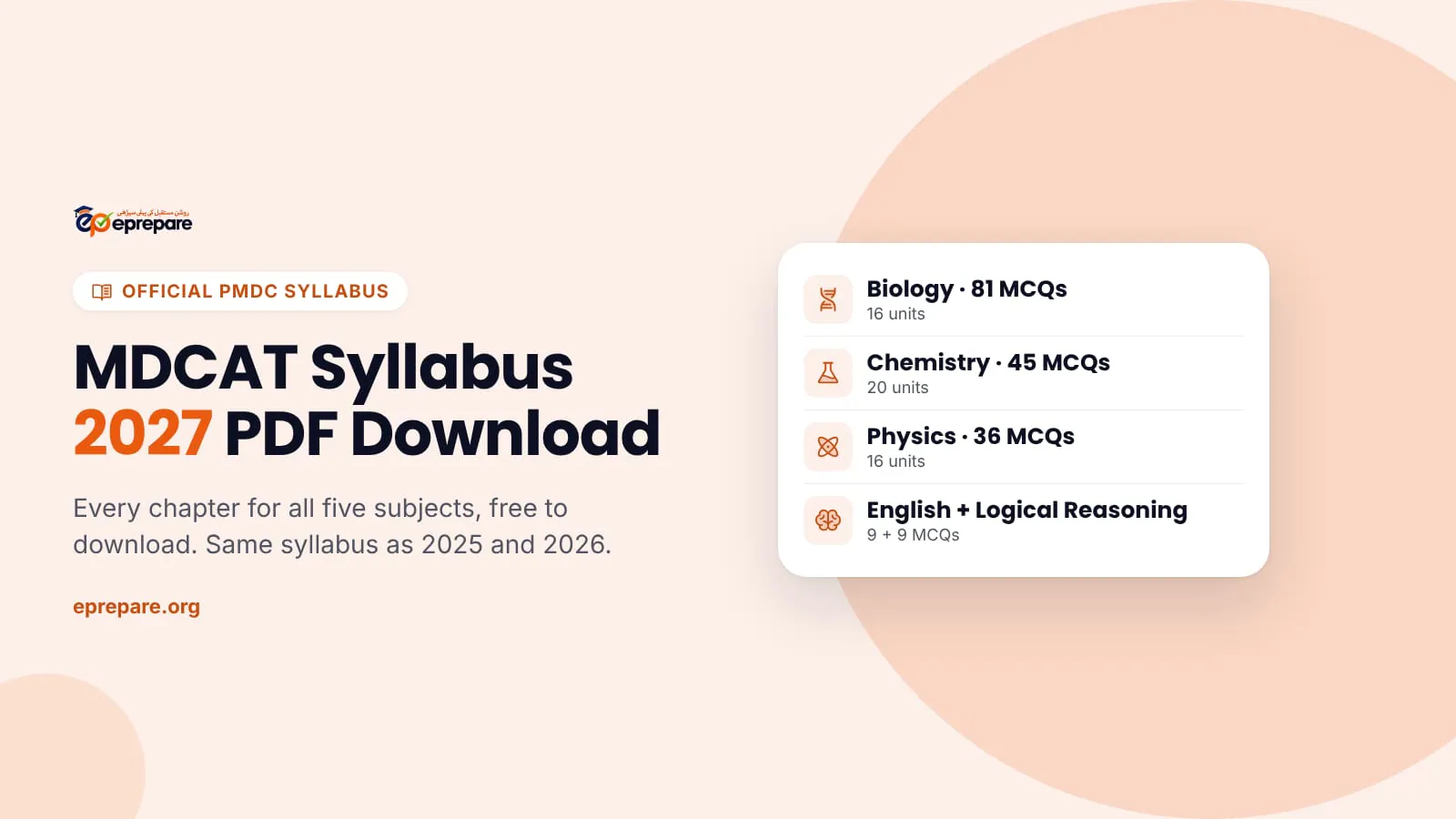
The short answer: MDCAT 2027 follows PMDC's Uniform Curriculum MDCAT-2025, the same syllabus used in MDCAT 2025 and MDCAT 2026. It has 61 units and 326 learning outcomes across Biology, Chemistry, Physics, English and Logical Reasoning, tested in 180 MCQs. Download the complete chapter-wise syllabus as a free PDF below.
Download MDCAT syllabus PDFOpen every unit and learning outcome
If you are starting MDCAT 2027 preparation now, the first thing you need is the exact syllabus, because the paper is set from it line by line. This page gives you the full PMDC syllabus in one place: a free PDF you can print, a chapter-wise list for every subject, the number of MCQs from each subject, and a plan for turning the syllabus into a study routine. Every chapter name below comes from PMDC's own curriculum document, not from a summary.
MDCAT syllabus PDF download (free, chapter-wise)
Our PDF lists every unit, topic and learning outcome in PMDC's uniform MDCAT curriculum, arranged subject by subject so you can tick off chapters as you finish them. It is 25 pages, works on any phone, and needs no sign-up.
- What's inside: all 16 Biology units, 20 Chemistry units, 16 Physics units, 3 English themes and 6 Logical Reasoning themes, with each learning outcome numbered as PMDC numbers it.
- Who it's for: every MDCAT candidate in Pakistan. Khyber Pakhtunkhwa, Punjab, Sindh, Balochistan, Islamabad, AJK and Gilgit-Baltistan all sit the same PMDC paper.
- Official copy: PMDC's own 24-page document is on its website: Uniform Curriculum MDCAT-2025 (official PMDC PDF), listed on PMDC's syllabus page.
Download the PDFView it online
Is the MDCAT 2027 syllabus the same as 2026 and 2025?
Yes. PMDC approved its new MDCAT curriculum in June 2025 and used it for MDCAT 2025. When it announced MDCAT 2026, PMDC's public notice of 19 May 2026 said in plain words:
"Furthermore, the MDCAT curriculum / syllabus-2025 will be applicable for the MDCAT-2026."
So the 2026 paper, held on 20 September 2026, was set from exactly the same syllabus as 2025. MDCAT 2027 is prepared from that same syllabus too: the five subjects, the 61 units, the 326 learning outcomes and the 180-MCQ pattern do not change. PMDC has kept this syllabus untouched since 2025; if it issues any notice about MDCAT 2027, we update this page the same day.
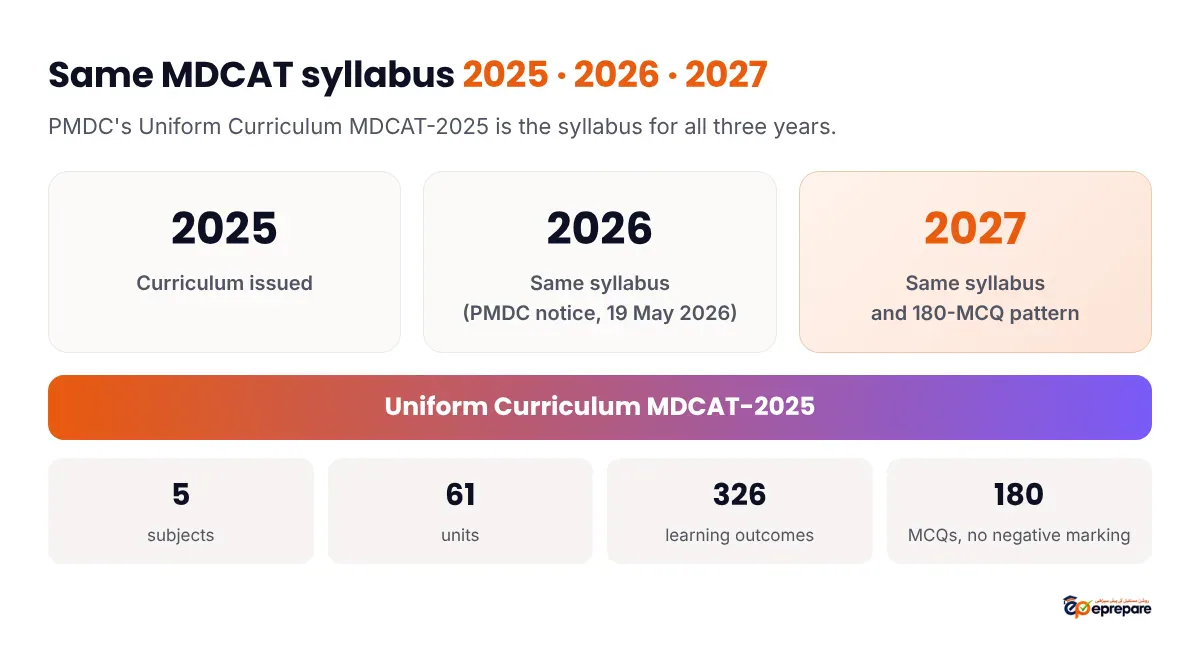
| MDCAT 2025 | MDCAT 2026 | MDCAT 2027 | |
|---|---|---|---|
| Syllabus | Uniform Curriculum MDCAT-2025 | Same (PMDC notice, 19 May 2026) | Same |
| Subjects | 5 | 5 | 5 |
| Units | 61 | 61 | 61 |
| Total MCQs | 180 | 180 | 180 |
| Negative marking | No | No | No |
| Time | 3 hours | 3 hours | 3 hours |
| Pass mark | 55% MBBS, 50% BDS | 55% MBBS, 50% BDS | 55% MBBS, 50% BDS |
This matters for your preparation in a practical way: everything written, taught and practised for the 2025 and 2026 papers still applies. Past papers from both years are the closest guide you have to how MDCAT 2027 will test the same chapters. You can practise them on our MDCAT past papers page.
MDCAT 2027 paper pattern and subject weightage
The MDCAT is one paper-based test of 180 multiple-choice questions in 3 hours. Each correct answer is one mark and there is no negative marking, so you should never leave a question blank. The split between subjects decides how you should divide your time.
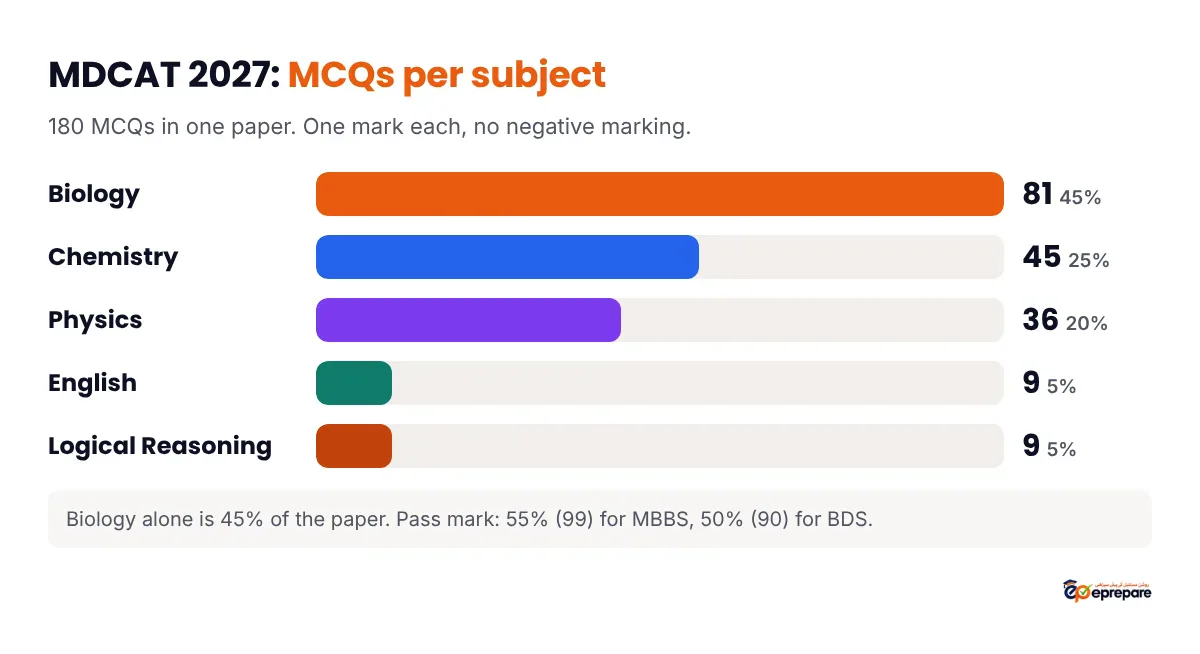
| Subject | MCQs | Share | Units | Learning outcomes |
|---|---|---|---|---|
| Biology | 81 | 45% | 16 | 69 |
| Chemistry | 45 | 25% | 20 | 120 |
| Physics | 36 | 20% | 16 | 100 |
| English | 9 | 5% | 3 | 21 |
| Logical Reasoning | 9 | 5% | 6 | 16 |
| Total | 180 | 100% | 61 | 326 |
Two numbers stand out. Biology alone is 81 MCQs, exactly as many as Chemistry and Physics together (45 + 36), so it deserves the biggest share of your hours. Chemistry has the most learning outcomes (120), which means a wide syllabus for 45 MCQs; it rewards steady revision rather than last-minute cramming. For a chapter-by-chapter view of which units bring the most questions, read our MDCAT chapter-wise weightage guide.
PMDC's curriculum also sets the difficulty mix: 15% easy, 70% moderate and 15% hard. On a 180-MCQ paper that is about 27 easy, 126 moderate and 27 hard questions, so most of your marks come from solid, standard MCQs rather than tricky ones.
What changed in the MDCAT syllabus since 2023?
If you are a repeater, or you are using older books and notes, this is the part to read carefully. PMDC's 2023 curriculum (also used in 2024) was replaced by the 2025 curriculum, and the paper changed with it. The table compares the two official PMDC documents.
| 2023 curriculum (2023, 2024) | 2025 curriculum (2025, 2026, 2027) | |
|---|---|---|
| Total MCQs | 200 | 180 |
| Time | 3.5 hours | 3 hours |
| Biology | 68 (34%) | 81 (45%) |
| Chemistry | 54 (27%) | 45 (25%) |
| Physics | 54 (27%) | 36 (20%) |
| English | 18 (9%) | 9 (5%) |
| Logical Reasoning | 6 (3%) | 9 (5%) |
| Pass mark (MBBS / BDS) | 65% / 55% | 55% / 50% |
| Difficulty (easy / moderate / hard) | 20 / 60 / 20 | 15 / 70 / 15 |
| Negative marking | None | None |
The units changed as well:
- Biology (13 units to 16): Biodiversity, Diversity among Animals, Prokaryotes and "Life processes in animals and plants" were taken out, and photosynthesis no longer appears. Acellular life, Circulation, Immunity, Respiration, Digestion, Homeostasis and Biotechnology now stand as their own units, with the focus on human biology.
- Chemistry (19 units to 20): Industrial chemistry was added.
- Physics (13 units to 16): Vectors and equilibrium, Fluid dynamics and Alternating current were added.
- English and Logical Reasoning: set out as 3 and 6 clear themes.
Watch out: some websites still show 200 MCQs and 3.5 hours, or 210 MCQs. Those are the old patterns. The current paper, for 2025, 2026 and 2027, is 180 MCQs in 3 hours.
MDCAT 2027 syllabus at a glance
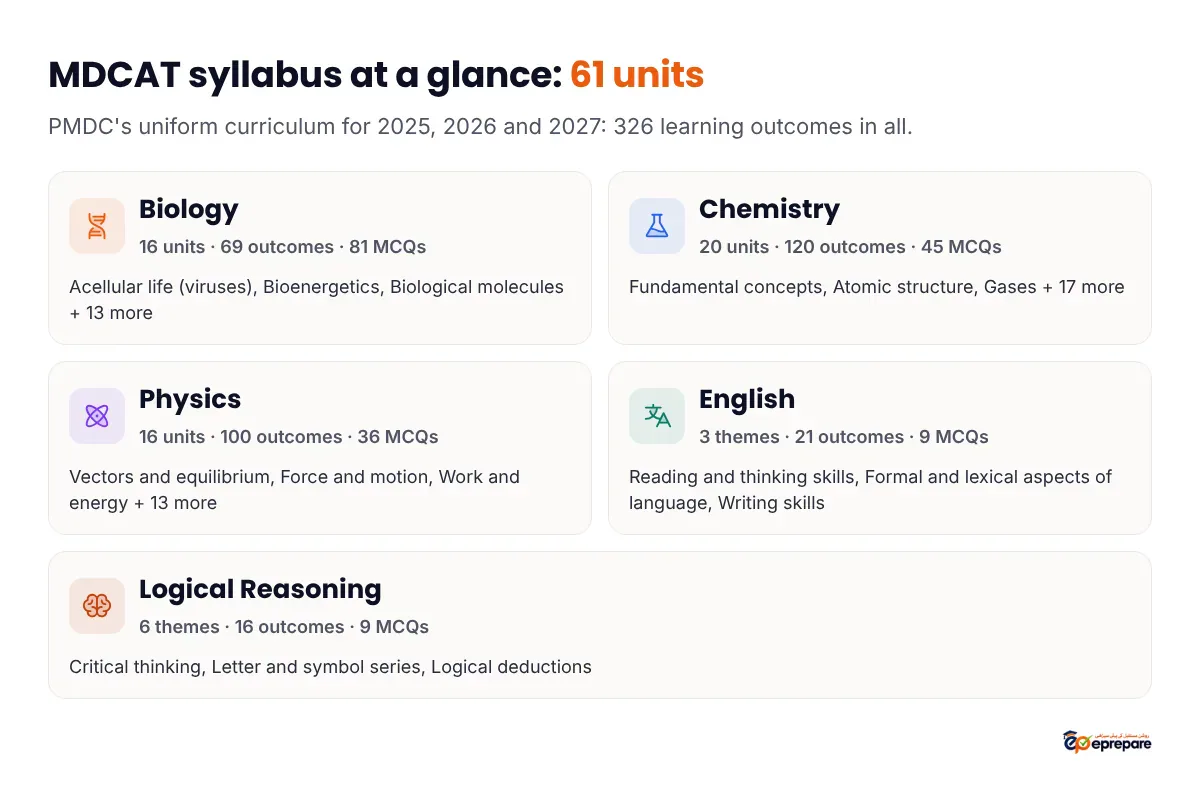
Below is the complete chapter-wise syllabus for each subject. The topics listed under each chapter are the headings PMDC uses; each one carries learning outcomes that say exactly what you should be able to do. Our full syllabus page shows every one of those 326 outcomes.
MDCAT Biology syllabus 2027 (16 units, 81 MCQs)
Biology is the largest part of the paper. The syllabus focuses on human biology (circulation, respiration, digestion, homeostasis, coordination, support and movement, reproduction and immunity) along with the cell, biological molecules, enzymes, bioenergetics, inheritance, evolution, viruses and biotechnology.
| Unit | Chapter | Topics in the PMDC syllabus |
|---|---|---|
| 1 | Acellular life (viruses) | Viruses, AIDS and HIV Infection |
| 2 | Bioenergetics | Respiration |
| 3 | Biological molecules | Biological molecules, Biological Importance of Water, Carbohydrates, Proteins, Lipids, Ribonucleic acid (RNA), Conjugated molecules, Structure of DNA |
| 4 | Cell structure and function | Cell structure, Prokaryotic and Eukaryotic cell, Cytoplasmic Organelles, Chromosomes |
| 5 | Coordination and control | Receptors, Neurons, Brain |
| 6 | Enzymes | Enzymes, Mode of Enzyme Action, Factors that Affect the Rate of Enzyme Reactions, Inhibitors |
| 7 | Evolution | Concept of Evolution, Lamarckism, Darwinism |
| 8 | Reproduction | Human Reproductive system, Menstrual cycle, Sexually transmitted diseases |
| 9 | Support and movement | Human skeleton, Muscles, Skeletal muscles, Muscle contraction, Joints, Arthritis |
| 10 | Inheritance | Mendel’s laws of Inheritance, Gene linkage and crossing over, X-linked Recessive inheritance |
| 11 | Circulation | Human Heart, Cardiac cycle and phases of Heartbeat, Blood Vessels, Lymphatic system |
| 12 | Immunity | Specific Defense Mechanism |
| 13 | Respiration | Human Respiratory System |
| 14 | Digestion | Human digestive system |
| 15 | Homeostasis | Urinary system and kidney, Homeostasis (kidney specifically), Thermoregulation, Excretion |
| 16 | Biotechnology | Biotechnology and Health Care |
Practise each chapter with MDCAT Biology MCQs, and read our high-yield Biology chapters guide to decide where to start.
MDCAT Chemistry syllabus 2027 (20 units, 45 MCQs)
Chemistry covers physical chemistry (moles, atomic structure, states of matter, equilibrium, kinetics, thermochemistry, electrochemistry), inorganic chemistry (bonding, s- and p-block and transition elements) and organic chemistry from basic principles to carboxylic acids, macromolecules and industrial chemistry.
| Unit | Chapter | Topics in the PMDC syllabus |
|---|---|---|
| 1 | Fundamental concepts | Moles and Avogadro’s Numbers, Limiting and Excess Reactants, Yield |
| 2 | Atomic structure | Discovery of Proton and Planck’s Quantum Theory, Quantum Number, Shapes of orbitals, Spectrum of Hydrogen, Electronic Configuration |
| 3 | Gases | Kinetic Molecular Theory, Standard Temperature and Pressure (STP), Boyle’s Law, Charles’s Law, Absolute Zero, Ideal Gas Equation, Unit of “R”, Real and Ideal Gas |
| 4 | Liquids | Properties Of Liquids based on Kinetic Molecular Theory, Evaporation, Boiling point and Vapor Pressure, Hydrogen Bonding, Anomalous behavior of Water |
| 5 | Solids | Crystalline Solids, Factors Affecting the Shape of Ionic Crystals, Difference between Ionic and Molecular Crystals, Crystal lattice, Lattice Energy |
| 6 | Chemical equilibrium | Chemical Equilibrium, Le Chatelier’s principle, Solubility Products, Common Ion Effect, Buffer Solution, Haber’s Process |
| 7 | Reaction kinetics | Chemical Kinetics, Factors affecting rate of reaction, Order of Reaction, Rate Constant |
| 8 | Thermochemistry | Thermodynamics, Exothermic and Endothermic Reaction, Different Terms Used, Internal Energies, Law of Thermodynamics, Hess’s Law, Enthalpy |
| 9 | Electrochemistry | Redox Reaction, Oxidation and Reduction, Balancing Chemical Reaction, Standard Hydrogen Electrode (SHE) |
| 10 | Chemical bonding | VSEPR Theory, Sigma and Pi Bond, Hybridization, Application of VSEPR Theory, Dipole Movement, Application of Dipole Movement, Bond Energy |
| 11 | S- and p-block elements | Properties and their Trends, S-, P-, D- & F- Block Elements, Reaction of Group I elements, Reaction of Group II elements, Reaction of Group IV elements |
| 12 | Transition elements | Electronic Structure |
| 13 | Fundamental principles of organic chemistry | Definition and Classification of Organic Compound, Functional Group, Isomerism |
| 14 | Hydrocarbons | Nomenclature of Alkanes, Free Radical Mechanism, Nomenclature of Alkenes, Shapes of Alkenes, Structure and Reactivity of Alkenes, Preparation of Alkanes, MOT of Benzene, Resonance and Resonance Energy, Reactivity of Benzene, Chemical Reactions of Benzenes, Effect of Substituents, IUPAC System of Alkynes, Preparation of Alkynes, Acidity of Alkynes, Reactions of Alkynes, Substitution vs Addition |
| 15 | Alkyl halides | Nomenclature Structure and Reactivity, Substitution vs Elimination |
| 16 | Alcohols and phenols | Nomenclature, structure and reactivity of Alcohol, Nomenclature, structure and reactivity of Phenols, Alcohols and Phenols |
| 17 | Aldehydes and ketones | Nomenclature and structure of Aldehydes and Ketones, Preparation, Reactivity of Aldehydes and Ketones, Reaction of Aldehydes and Ketones |
| 18 | Carboxylic acids | Nomenclature, Structure and Preparation of Carboxylic Acid, Chemical Reactions/Reactivity, Conversion of Carboxylic Acid |
| 19 | Macromolecules | Classification of Proteins, Importance of Proteins, Enzymes as Biocatalyst |
| 20 | Industrial chemistry | Adhesive, Dyes, Polymers |
Practise with MDCAT Chemistry MCQs and see which units matter most in our high-yield Chemistry chapters guide.
MDCAT Physics syllabus 2027 (16 units, 36 MCQs)
Physics runs from vectors and motion through energy, rotation, fluids, waves and thermodynamics to electricity and magnetism, AC circuits, electronics and modern physics. Most MCQs need short calculations, so practise numericals without a calculator from the start.
| Unit | Chapter | Topics in the PMDC syllabus |
|---|---|---|
| 1 | Vectors and equilibrium | Addition of Vectors (Rectangular Components), Product of Vectors (Scalar Product), Product of Vectors (Vector Product) |
| 2 | Force and motion | Displacement, Velocity, Displacement-time Graph, Acceleration, Uniform and variable acceleration, Projectile motion, Ideal Projectile, Projectile motion (Velocity), Projectile motion: maximum height, range, time of flight, maximum angle, Newton’s Laws of motion, Newton’s Second Law and Linear momentum, Newton’s third law of motion, Collision, Momentum and Explosive forces, Perfectly elastic collision in one dimension |
| 3 | Work and energy | Work, Energy, Kinetic Energy, Potential energy, Absolute potential energy, Power, Work energy theorem in resistive medium, Implications of energy losses in practical devices and Efficiency |
| 4 | Rotational and circular motion | Angular displacement, Angular Velocity, Relation between angular and linear quantities |
| 5 | Fluid dynamics | Terminal Velocity, Fluid Drag, Fluid Flow, Equation of Continuity, Bernoulli’s Equation |
| 6 | Waves and simple harmonic motion | Motion of wave, Progressive waves, Characteristics of wave, Wave Speed, Progressive waves, Classification of progressive waves, Speed of sound and Newton’s formula for speed of sound in air, Laplace’s Correction, Effect of various factors on speed of sound, Superposition of waves, Interference of sound waves, Stationary waves, Stationary waves in a stretched string, Organ pipes, Superposition of waves, Simple Harmonic Motion, Terminologies of SHM, Circular motion and SHM, Energy, Circular Motion and SHM (Acceleration and Velocity of Projection) |
| 7 | Thermodynamics | Thermal equilibrium, Heat, Molar specific heat of gas, Work, First law of thermodynamics, Molar specific heat of gas, Relation between molar specific heat at constant volume and constant pressure |
| 8 | Electrostatics | Columb’s Law, Electric Field, Electric field intensity due to a point charge and representation of electric field by lines, Electric field intensity due to an infinite sheet of charges, Electric potential energy and potential due to a point charge, Electric potential, Electric potential energy and potential due to a point charge, Charging and discharging of a capacitor through a resistance |
| 9 | Current electricity | Steady current, Ohm’s Law, Factors on which resistance depends and temperature coefficient of resistivity, Internal resistance of sources, Maximum power Output |
| 10 | Electromagnetism | Magnetic flux density/Magnetic field, Magnetic flux, Motion of charged particle in magnetic field |
| 11 | Electromagnetic induction | Faraday’s Law of electromagnetic, Lenz’s Law, Transformer |
| 12 | Alternating current | Phase of Alternating Current, AC through a. Resistor b. Capacitor. c. Inductor, Electromagnetic waves |
| 13 | Electronics | Rectification, PN Junction |
| 14 | Dawn of modern physics | Quantum Theory and Radiation |
| 15 | Atomic spectra | Atomic Spectra |
| 16 | Nuclear physics | Composition of atomic nuclei, Spontaneous and random nuclear decay, Half-life and rate of decay, Biological and Medical uses of radiation |
Practise with MDCAT Physics MCQs and read our high-yield Physics chapters guide.
MDCAT English syllabus 2027 (3 themes, 9 MCQs)
English has no chapters to memorise. PMDC tests three skills, and the 9 MCQs are some of the quickest marks in the paper if you have practised the question types.
| Theme | Area | What it tests |
|---|---|---|
| 1 | Reading and thinking skills | Reading a passage and answering on its meaning, tone, main idea and inference. |
| 2 | Formal and lexical aspects of language | Grammar, sentence correction, punctuation, vocabulary, synonyms and antonyms, word usage. |
| 3 | Writing skills | Recognising a well-built sentence and paragraph: order, linking words and clear expression. |
See the exact grammar areas that come up in our MDCAT English grammar topics guide.
MDCAT Logical Reasoning syllabus 2027 (6 themes, 9 MCQs)
Logical Reasoning checks how you think, not what you have memorised. Each theme has its own question style, and a few days of focused practice usually lifts this section quickly.
| Theme | Area | What it tests |
|---|---|---|
| 1 | Critical thinking | Spotting assumptions, strong and weak arguments, and conclusions that do or do not follow. |
| 2 | Letter and symbol series | Finding the next letter, number or symbol in a series. |
| 3 | Logical deductions | Drawing a valid conclusion from given statements (syllogisms, if-then). |
| 4 | Logical problems | Arrangement, ranking, direction and similar short puzzles. |
| 5 | Course of action | Choosing the most sensible action for a stated problem. |
| 6 | Cause and effect | Telling a cause from its effect in a pair of events. |
Try worked examples in our MDCAT Logical Reasoning questions guide.
Is the MDCAT syllabus the same for every province and board?
Yes. PMDC sets one uniform curriculum for the whole country, so a student from KPK, Punjab, Sindh, Balochistan or the Federal board studies the same units for the same paper. What changes from province to province is the university that runs admissions (KMU, UHS and others) and the merit list you compete in, not the syllabus.
The curriculum is built from FSc (intermediate) Part I and Part II content, but it does not follow any single board's textbook chapter by chapter. A topic can sit in a different chapter of your board's book, and a few FSc topics are not in the MDCAT syllabus at all. That is why it pays to study from the syllabus list, then use your textbook to read each topic.
NUMS is different. The National University of Medical Sciences sets its own entrance syllabus and pattern for its colleges. If you are applying there too, compare the two in our PMDC MDCAT vs NUMS MDCAT guide.
How to use the MDCAT 2027 syllabus to plan your preparation
- Print the PDF and keep it beside you. Tick each learning outcome when you can explain it without the book. A chapter is done only when every outcome is ticked.
- Split your hours by MCQs, not by chapters. Biology brings 81 marks, so it gets the most time. Then Chemistry, then Physics. Keep English and Logical Reasoning to a short daily slot.
- Study one unit, then test it the same day. Reading alone feels like progress; MCQs show whether it stuck. Topic-wise practice right after reading is the fastest way to find gaps.
- Revise on a schedule. Come back to each finished unit after a few days and again after a few weeks. Mistakes you note down are the best revision list you will ever have.
- Finish with full-length papers. In the last two months, sit timed 180-MCQ papers to build speed and stamina for the real day.
If you want a ready timetable, start with our MDCAT study plan guide or the 90-day MDCAT study plan.
Prepare for MDCAT 2027 with ePrepare
ePrepare is built around this exact syllabus. Every MCQ in our question bank is tagged to its PMDC subject, chapter and topic, so you can practise any unit of the syllabus the moment you finish reading it.
- Chapter-wise and topic-wise MCQs for all five subjects, with explanations.
- Conceptual notes written unit by unit against the PMDC syllabus, with easy Urdu boxes for hard ideas.
- Full-length papers (FLPs) in the real 180-MCQ pattern, plus past papers from previous years.
- A study plan and Mistake Diary that keep track of what you have covered and what you got wrong.
See what each package includes on our packages page, or try a free MDCAT online test first.
Frequently asked questions
What is the MDCAT 2027 syllabus?
MDCAT 2027 follows PMDC's Uniform Curriculum MDCAT-2025: 16 Biology units, 20 Chemistry units, 16 Physics units, 3 English themes and 6 Logical Reasoning themes, with 326 learning outcomes in total.
Is the MDCAT 2027 syllabus changed?
No. The syllabus used for MDCAT 2025 was applied again for MDCAT 2026 by PMDC's notice of 19 May 2026, and MDCAT 2027 keeps the same syllabus and 180-MCQ pattern.
Where can I download the MDCAT syllabus PDF?
Download it free from this page using the "Download MDCAT syllabus PDF" button. It lists every unit, topic and learning outcome, and needs no sign-up.
How many MCQs are in MDCAT 2027?
180 MCQs: Biology 81, Chemistry 45, Physics 36, English 9 and Logical Reasoning 9. Each correct answer is one mark and there is no negative marking.
How many chapters are in the MDCAT syllabus?
61 units: Biology 16, Chemistry 20, Physics 16, English 3 themes and Logical Reasoning 6 themes.
Is the MDCAT syllabus the same for KPK, Punjab and Sindh?
Yes. PMDC's curriculum is uniform across Pakistan. The admitting university and merit list differ by province, but the syllabus and the paper do not.
Is MDCAT based on FSc books?
The syllabus is drawn from FSc Part I and Part II, but it is organised by PMDC's own units and outcomes, not by any one board's book. Study from the syllabus list and use your textbook to read each topic.
What are the passing marks for MDCAT 2027?
55% (99 out of 180) for MBBS and 50% (90 out of 180) for BDS. Passing only makes you eligible; admission depends on your merit. See our MDCAT passing marks guide.
Is the NUMS syllabus the same as the MDCAT syllabus?
No. NUMS sets its own entrance syllabus and paper pattern for its colleges, which differs from PMDC's MDCAT. Compare them in our PMDC vs NUMS guide.
Which subject has the most weightage in MDCAT?
Biology, with 81 of 180 MCQs (45%), as many as Chemistry (45) and Physics (36) together.
Is MDCAT 180 or 200 MCQs?
180 MCQs in 3 hours. The 200-MCQ, 3.5-hour pattern belonged to the 2023 curriculum and was replaced in 2025.
Is MDCAT paper-based or computer-based?
PMDC's curriculum describes MDCAT as a paper-based MCQ test of 3 hours.
Is photosynthesis in the MDCAT syllabus?
No. Photosynthesis was part of the 2023 curriculum but does not appear in the 2025 curriculum, which is the syllabus for MDCAT 2025, 2026 and 2027. Bioenergetics now covers respiration.
When will MDCAT 2027 be held?
PMDC has not announced the MDCAT 2027 date yet. The government has said it wants the test held soon after the FSc exams, so plan to be ready earlier than in past years. Follow our MDCAT date and registration guide for the official date.
Should I start MDCAT 2027 preparation now?
Yes. The syllabus is already fixed, so there is nothing to wait for. Starting early also protects you if the test moves closer to your FSc exams.