

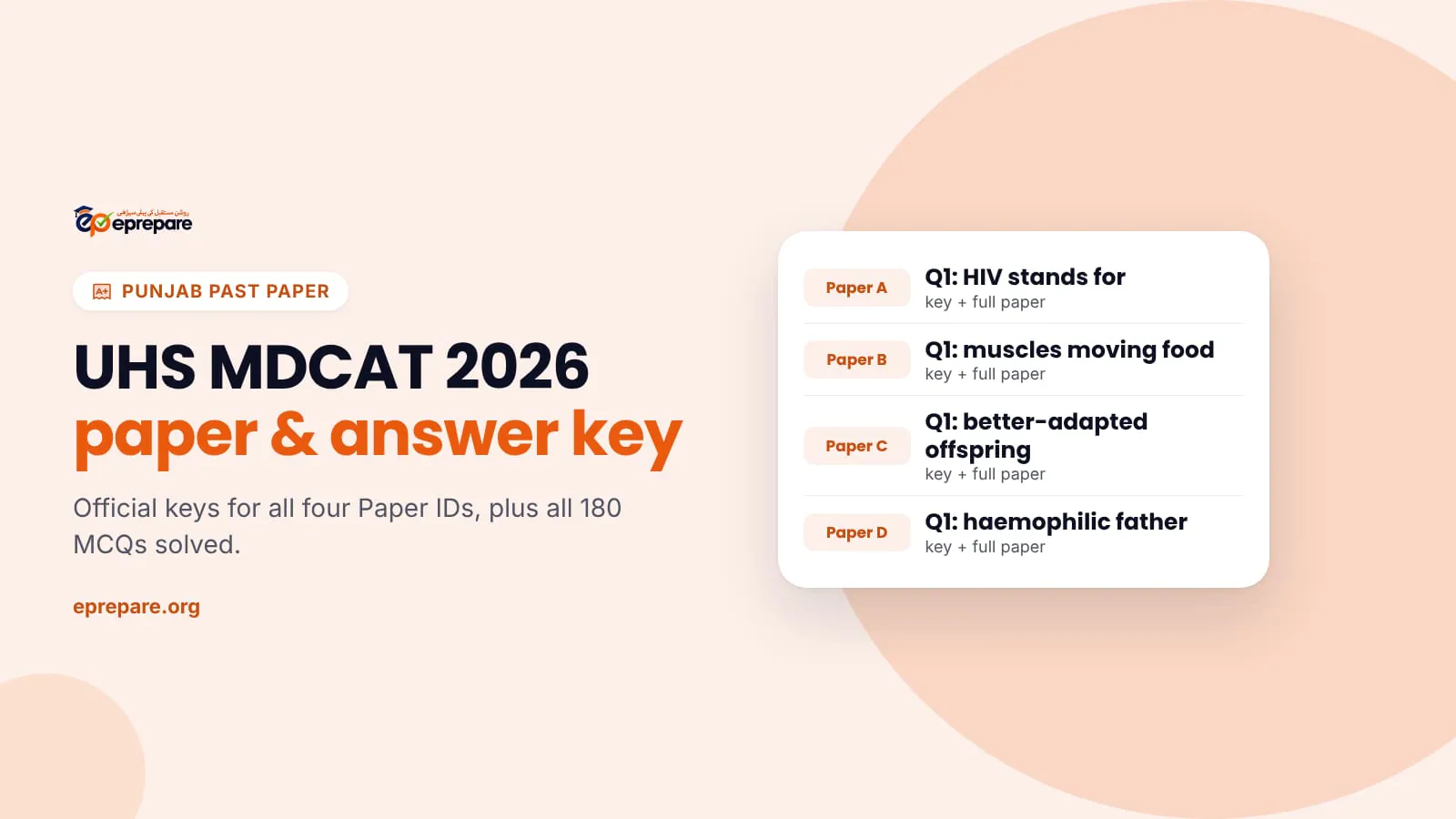
The UHS MDCAT 2026 was held on Sunday, 20 September 2026 across Punjab, and the University of Health Sciences, Lahore released its official answer keys the same night. The paper came in four versions, Paper ID A, B, C and D. On this page you get the official key for every Paper ID, typed out and as the signed UHS image, the full question paper, and all 180 MCQs of Paper A solved with a short explanation for each answer.
Quick way: find your Paper ID on the first page of your question paper (or the ID circle you filled on the response form), jump to that key below, and count your matches. Use only your own Paper ID's key: the questions are the same in all four papers, but their order is not.
All four Paper IDs at a glance
| Paper ID | Question 1 starts with | Answer key | Question paper |
|---|---|---|---|
| A | HIV stands for: | Paper A key below | View |
| B | The type of muscles responsible for the movement of food through lumen of intestine are: | Paper B key below | View |
| C | The offsprings of better-adapted individuals are expected to make up a larger proportion of the next generation. The most likely explanation is: | Paper C key below | View |
| D | A hemophilic father can pass the genes of hemophilia to his: | Paper D key below | View |
UHS MDCAT 2026 in short
| Conducted by | University of Health Sciences (UHS), Lahore, for Punjab |
|---|---|
| Test date and time | Sunday, 20 September 2026, 10 am to 1 pm (first set for 16 August, then moved) |
| Centres | 31 centres in 15 cities of Punjab, six of them in Lahore |
| Paper | 180 MCQs, 180 marks, 3 hours, for F.Sc. and non-F.Sc. students |
| Negative marking | None: a wrong answer costs nothing |
| Paper IDs | A, B, C and D, each with its own key |
| Candidates | About 49,200 registered; 47,475 appeared |
| Result | Announced on 24 September 2026 |
| Qualified | 37,708 for MBBS (79.43%) and 40,457 for BDS (85.22%) |
| PMDC passing marks | 55% (99/180) for MBBS and 50% (90/180) for BDS |
How to find your Paper ID

UHS made the Paper ID a compulsory question: every candidate had to fill the circle for their ID on the response form. If you no longer have the paper, match the first question you remember with the table above. Paper A opens with "HIV stands for", Paper B with the muscles that move food through the intestine, Paper C with better-adapted offspring and Paper D with a haemophilic father.
Paper ID A answer key (all 180 MCQs)
Paper A starts with "HIV stands for:" Read across a row: in the row 31–40, column 7 is the answer to Question 37.
| Questions | 1 | 2 | 3 | 4 | 5 | 6 | 7 | 8 | 9 | 10 |
|---|---|---|---|---|---|---|---|---|---|---|
| 1–10 | A | B | D | A | A | B | A | B | C | B |
| 11–20 | A | C | C | D | B | D | C | D | B | B |
| 21–30 | B | C | C | B | C | C | C | A | C | D |
| 31–40 | B | B | B | A | C | B | A | B | A | A |
| 41–50 | B | B | B | C | D | D | C | D | B | C |
| 51–60 | B | C | B | B | D | B | A | C | B | B |
| 61–70 | D | B | D | B | B | C | A | B | B | D |
| 71–80 | C | B | C | A | C | C | A | D | B | C |
| 81–90 | A | D | B | B | D | C | B | A | C | B |
| 91–100 | C | C | D | A | D | B | B | A | B | A |
| 101–110 | D | B | C | C | B | B | C | B | D | A |
| 111–120 | B | B | A | B | A | B | B | B | A | D |
| 121–130 | C | D | B | C | C | C | D | D | C | C |
| 131–140 | C | B | B | C | B | C | B | B | C | B |
| 141–150 | A | A | C | B | D | C | B | D | C | A |
| 151–160 | C | B | D | B | B | B | C | B | D | D |
| 161–170 | C | D | C | A | B | A | D | B | C | D |
| 171–180 | A | C | C | D | A | D | C | D | D | A |

Open Paper A in Google DriveOpen the Paper A key in Google Drive
Read the Paper A question paper here (18 pages)
Paper ID B answer key (all 180 MCQs)
Paper B starts with "The type of muscles responsible for the movement of food through lumen of intestine are:" Read across a row: in the row 31–40, column 7 is the answer to Question 37.
| Questions | 1 | 2 | 3 | 4 | 5 | 6 | 7 | 8 | 9 | 10 |
|---|---|---|---|---|---|---|---|---|---|---|
| 1–10 | A | C | C | D | B | D | C | D | B | B |
| 11–20 | B | C | C | B | C | C | C | A | C | D |
| 21–30 | B | B | B | A | C | B | A | B | A | A |
| 31–40 | B | B | B | C | D | D | C | D | B | C |
| 41–50 | B | C | B | B | D | B | A | C | B | B |
| 51–60 | D | B | D | B | B | C | A | B | B | D |
| 61–70 | C | B | C | A | C | C | A | D | B | C |
| 71–80 | A | A | B | D | A | A | B | A | B | C |
| 81–90 | B | C | D | A | D | B | B | A | B | A |
| 91–100 | D | B | C | C | B | B | C | B | D | A |
| 101–110 | B | B | A | B | A | B | B | B | A | D |
| 111–120 | C | D | B | C | C | C | D | B | B | D |
| 121–130 | C | B | A | C | B | C | B | B | C | B |
| 131–140 | A | A | C | B | D | C | B | D | C | A |
| 141–150 | C | B | D | B | B | B | C | B | D | D |
| 151–160 | C | D | D | D | C | C | C | B | B | C |
| 161–170 | B | C | D | B | C | D | A | C | A | B |
| 171–180 | A | D | C | D | D | A | C | C | D | A |

Open Paper B in Google DriveOpen the Paper B key in Google Drive
Read the Paper B question paper here (18 pages)
Paper ID C answer key (all 180 MCQs)
Paper C starts with "The offsprings of better-adapted individuals are expected to make up a larger proportion of the next generation. The most likely explanation is:" Read across a row: in the row 31–40, column 7 is the answer to Question 37.
| Questions | 1 | 2 | 3 | 4 | 5 | 6 | 7 | 8 | 9 | 10 |
|---|---|---|---|---|---|---|---|---|---|---|
| 1–10 | C | C | B | C | C | C | A | C | D | B |
| 11–20 | B | B | A | C | B | A | B | A | A | B |
| 21–30 | B | B | C | D | D | C | D | B | C | B |
| 31–40 | C | B | B | D | B | A | C | B | B | D |
| 41–50 | B | D | B | B | C | A | B | B | D | C |
| 51–60 | B | C | A | C | C | A | D | B | C | A |
| 61–70 | A | B | D | A | A | B | A | B | C | B |
| 71–80 | A | C | C | D | B | D | C | D | B | B |
| 81–90 | B | B | C | C | B | B | C | B | D | A |
| 91–100 | B | B | A | B | A | B | B | B | A | D |
| 101–110 | C | D | B | C | C | C | D | B | B | D |
| 111–120 | C | B | A | C | B | C | C | D | A | D |
| 121–130 | B | B | A | B | A | D | B | D | C | A |
| 131–140 | C | B | D | B | B | B | C | B | D | D |
| 141–150 | C | D | D | D | C | C | C | B | B | C |
| 151–160 | B | C | B | B | C | B | A | A | C | B |
| 161–170 | D | C | D | A | C | A | B | A | D | B |
| 171–180 | C | D | A | C | C | D | A | D | C | D |

Open Paper C in Google DriveOpen the Paper C key in Google Drive
Read the Paper C question paper here (18 pages)
Paper ID D answer key (all 180 MCQs)
Paper D starts with "A hemophilic father can pass the genes of hemophilia to his:" Read across a row: in the row 31–40, column 7 is the answer to Question 37.
| Questions | 1 | 2 | 3 | 4 | 5 | 6 | 7 | 8 | 9 | 10 |
|---|---|---|---|---|---|---|---|---|---|---|
| 1–10 | B | B | A | C | B | A | B | A | A | B |
| 11–20 | B | B | C | D | D | C | D | B | C | B |
| 21–30 | C | B | B | D | B | A | C | B | B | D |
| 31–40 | B | D | B | B | C | A | B | B | D | C |
| 41–50 | B | C | A | C | C | A | D | B | C | A |
| 51–60 | A | B | D | A | A | B | A | B | C | B |
| 61–70 | A | C | C | D | B | D | C | D | B | B |
| 71–80 | B | C | C | B | C | C | C | A | C | D |
| 81–90 | B | B | A | B | A | B | B | B | A | D |
| 91–100 | C | D | B | C | C | C | D | B | B | D |
| 101–110 | C | B | A | C | B | C | C | D | A | D |
| 111–120 | B | B | A | B | A | D | B | C | C | B |
| 121–130 | B | C | B | D | A | B | C | B | D | D |
| 131–140 | C | D | D | D | C | C | C | B | B | C |
| 141–150 | B | C | B | B | C | B | A | A | C | B |
| 151–160 | D | C | B | D | C | A | C | B | D | B |
| 161–170 | B | B | A | D | A | B | A | D | B | C |
| 171–180 | C | A | D | C | D | A | D | D | C | C |

Open Paper D in Google DriveOpen the Paper D key in Google Drive
Read the Paper D question paper here (18 pages)
UHS MDCAT 2026 paper pattern
The paper follows PMDC's MDCAT pattern. In Paper A each subject sits in one block:

| Subject | MCQs | Questions (Paper A) | Share of paper |
|---|---|---|---|
| Biology | 81 | 1–81 | 45% |
| Chemistry | 45 | 82–126 | 25% |
| Physics | 36 | 127–162 | 20% |
| English | 9 | 163–171 | 5% |
| Logical reasoning | 9 | 172–180 | 5% |
| Total | 180 | 1–180 | 100% |
All four keys have exactly the same number of A, B, C and D answers (31, 64, 50 and 35), because the four papers carry the same 180 questions in a different order. No Paper ID was easier than another. See the MDCAT paper pattern for how PMDC sets these numbers.
How to check your score with the key
- Pick the key of your Paper ID. Another ID's key will mark you wrong on most questions.
- Write your answers from the carbon copy of your response form next to the question numbers, 1 to 180.
- Compare each answer with the key and count the matches. Each correct answer is one mark; a wrong or blank answer is zero, because there was no negative marking.
- Your score out of 180 is the number of matches. Divide it by 1.8 for your percentage: 144 correct is 80%.
- Compare it with the passing marks: at least 99 for MBBS and 90 for BDS. Passing makes you eligible; admission then depends on your merit aggregate.
Then see where that score stands. The UHS merit calculator turns it into your Punjab aggregate, and the UHS closing merit page shows the last merit of every college. Our guide on how to check your MDCAT result covers the official result page.
UHS MDCAT 2026 result: how candidates scored

| Marks out of 180 | Candidates | Share | At or above this band |
|---|---|---|---|
| 170–180 | 1,772 | 3.7% | 1,772 (3.7%) |
| 160–169 | 6,682 | 14.1% | 8,454 (17.8%) |
| 150–159 | 6,260 | 13.2% | 14,714 (31.0%) |
| 140–149 | 5,357 | 11.3% | 20,071 (42.3%) |
| 130–139 | 4,939 | 10.4% | 25,010 (52.7%) |
| 120–129 | 4,382 | 9.2% | 29,392 (61.9%) |
| 110–119 | 4,188 | 8.8% | 33,580 (70.7%) |
| 100–109 | 3,766 | 7.9% | 37,346 (78.7%) |
| 90–99 | 3,111 | 6.6% | 40,457 (85.2%) |
| 89 or less | 7,018 | 14.8% | 47,475 (100.0%) |
So 14,714 candidates (31%) scored 150 or more, and 8,454 (17.8%) scored 160 or more. Admission then depends on your aggregate, not the MDCAT score alone: see how MBBS merit is calculated and the UHS admission policy.
What came in each subject
Question numbers below are from Paper A. The same questions are in Papers B, C and D at other numbers.
Biology (81 MCQs)
- Digestion was the biggest topic with 12 MCQs: the oesophagus, the stomach mucosa, mastication, peristalsis and enzymes (Q2, Q8, Q11, Q13, Q24, Q27, Q39, Q40, Q56, Q62–64).
- Nervous coordination: receptors (Pacinian corpuscles, mechano- and chemoreceptors), nerve impulses and reflexes (Q3–5, Q15–17, Q25, Q35, Q37, Q47, Q49, Q73).
- Homeostasis and the kidney (Q23, Q26, Q29, Q30, Q45, Q48, Q52), inheritance (Q32, Q43, Q46, Q66, Q75, Q80) and cell structure (Q21, Q34, Q41, Q44, Q67).
- Molecules of life: mRNA share of cellular RNA, the Watson and Crick model, gene expression and a coding-strand question (Q7, Q12, Q28, Q69, Q72).
- Also asked: viruses and HIV (Q1, Q31, Q42), Lamarck and evolution (Q9, Q22, Q70), reproduction and hormones (Q14, Q51, Q57, Q59, Q78), immunity (Q18, Q53, Q68), the heart (Q55, Q61, Q65), muscles and bones (Q6, Q10, Q36, Q50, Q74, Q77) and enzymes (Q19, Q38, Q71).
Chemistry (45 MCQs)
- Physical chemistry: percentage yield (Q91, Q92), gas laws and molar volume (Q89, Q93, Q104, Q121, Q122), rate laws (Q95, Q105, Q111), solubility product (Q115), electrochemistry (Q108) and thermodynamics (Q125).
- Atomic structure and periodicity: orbitals and quantum numbers (Q85, Q86, Q88, Q97, Q107), electronic configuration (Q123), lattice energy and periodic trends (Q100, Q124, Q126) and transition elements (Q102).
- Organic chemistry: E1 reactions (Q94), Grignard reagent with methanal (Q87, Q96), hydration of alkynes (Q98), benzene's stability (Q99), oxidation of alcohols (Q101), the iodoform test (Q103), isomerism (Q112), polymers (Q113, Q118) and carbonyl compounds (Q119, Q120).
Physics (36 MCQs)
- Thermodynamics and heat (Q130, Q145–147, Q150) and waves, including slinky springs, interference and stationary waves (Q127–129, Q152, Q153, Q158, Q162).
- Mechanics: velocity-time graphs (Q131, Q133), momentum and force (Q132, Q141), work and energy (Q142, Q151), vectors (Q143), projectiles (Q157), angular velocity (Q160) and fluid flow (Q140, Q144, Q148).
- Electricity and modern physics: Lenz's law and induced emf (Q134, Q137), potential difference (Q138, Q159), transformers (Q149), current (Q154), rectification (Q161), half-life (Q136, Q156), radioisotopes in medicine (Q155) and atomic spectra (Q139).
English and logical reasoning (9 + 9 MCQs)
English tested relative pronouns (Q163), punctuation (Q164), words in context such as "head of the table" (Q165, Q171), direct and indirect speech (Q166, Q167), phrasal verbs (Q168), active and passive voice (Q169) and adverbs (Q170). Logical reasoning had a critical-thinking item (Q172), a lab-safety problem (Q173), an odd one out (Q174), a letter analogy (Q175), blood relations (Q176), a number series (Q177), a quantity comparison (Q178), an arrangement puzzle (Q179) and percentages (Q180).
UHS MDCAT 2026 solved paper: all 180 MCQs (Paper A)
Every question of Paper A, word for word, with its four options. Try each one first, then open it for the official answer and a short explanation. Students with Paper B, C or D will find the same questions here at different numbers.
Biology (Q1–81, 81 MCQs)
Q1. HIV stands for:
(a) Human Immunodeficiency Virus
(b) Human Internal Virus
(c) High Impact Virus
(d) Human Immunogenic Vaccine
Answer: (a) Human Immunodeficiency Virus. HIV is the Human Immunodeficiency Virus, a retrovirus that destroys helper T cells and causes AIDS.
Q2. The part of digestive system which is NOT directly involved in digestion is:
(a) Mouth
(b) Oesophagus
(c) Stomach
(d) Small intestine
Answer: (b) Oesophagus. The oesophagus only carries food from pharynx to stomach by peristalsis; it secretes no digestive enzymes, while mouth, stomach and small intestine all digest food.
Q3. Pacinian corpuscles are present in the:
(a) Retina
(b) Lungs
(c) Liver
(d) Skin
Answer: (d) Skin. Pacinian corpuscles are pressure receptors located deep in the dermis of the skin.
Q4. The receptors for hearing and equilibrium are the example of:
(a) Mechanoreceptors
(b) Thermoreceptors
(c) Nociceptors
(d) Photoreceptors
Answer: (a) Mechanoreceptors. Hair cells of the inner ear respond to mechanical bending caused by sound waves and head movement, so they are mechanoreceptors.
Q5. Receptors that detect smell of food are:
(a) Chemoreceptors
(b) Mechanoreceptors
(c) Nociceptors
(d) Photoreceptors
Answer: (a) Chemoreceptors. Olfactory receptors respond to dissolved chemical molecules, so they are chemoreceptors.
Q6. The most abundant voluntary muscles in human body are:
(a) Cardiac
(b) Skeletal
(c) Smooth
(d) Smooth & Cardiac
Answer: (b) Skeletal. Skeletal muscles are the voluntary muscles attached to bones and form the largest muscle mass of the body.
Q7. mRNA forms ____ % of the total RNA in the cell
(a) 3-4%
(b) 4-5%
(c) 5-6%
(d) 6-7%
Answer: (a) 3-4%. mRNA makes up only about 3-4% of total cellular RNA; rRNA is about 80% and tRNA about 15%.
Q8. The inner layer of stomach whose glands secrete digestive enzymes, HCl and mucus is known as:
(a) submucosa
(b) mucosa
(c) muscularis
(d) serosa
Answer: (b) mucosa. The mucosa is the innermost lining of the stomach and contains gastric glands that secrete pepsinogen, HCl and mucus.
Q9. According to Lamarck, the characteristics which are developed during the lifetime of an individual due to use and disuse of organs are called as:
(a) prominent characters
(b) biological characters
(c) acquired characters
(d) physical characters
Answer: (c) acquired characters. Lamarck proposed that traits gained during life through use and disuse are acquired characters passed on to offspring.
Q10. The collagen fibers of bone are hardened by deposition of:
(a) Calcium and oxalates
(b) Calcium and phosphates
(c) Magnesium and nitrates
(d) Iron and glycogen
Answer: (b) Calcium and phosphates. Bone matrix is hardened by calcium phosphate (hydroxyapatite) crystals deposited on collagen fibres.
Q11. The type of muscles responsible for the movement of food through lumen of intestine are:
(a) Smooth muscles
(b) Cardiac muscles
(c) Skeletal muscles
(d) Skeletal & cardiac muscles
Answer: (a) Smooth muscles. Involuntary smooth muscles in the intestinal wall contract rhythmically (peristalsis) to push food along the lumen.
Q12. According to Watson and Crick's model, each complete turn of the DNA double helix, consists of:
(a) 6 base pairs
(b) 8 base pairs
(c) 10 base pairs
(d) 12 base pairs
Answer: (c) 10 base pairs. In the Watson-Crick model, one complete turn of the helix is 3.4 nm long and contains 10 base pairs, each 0.34 nm apart.
Q13. The major purpose of mastication is to:
(a) Make morsel soft
(b) Make food moist
(c) Increase surface area
(d) Improve the taste
Answer: (c) Increase surface area. Chewing breaks food into small pieces, increasing the surface area for digestive enzymes to act on.
Q14. Which of the following hormones stimulates the development of primary follicles in the ovary?
(a) Estrogen
(b) Progesterone
(c) Luteinizing hormone
(d) Follicle stimulating hormone
Answer: (d) Follicle stimulating hormone. FSH from the anterior pituitary stimulates primary follicles in the ovary to develop and mature.
Q15. What unique characteristic is typically found in sensory neurons of spinal nerves?
(a) A single axon
(b) A single dendron
(c) Multiple dendrites
(d) Multiple nodes of Ranvier
Answer: (b) A single dendron. Sensory neurons have a single long dendron that carries impulses from receptors towards the cell body in the dorsal root ganglion.
Q16. In which part of the neuron, Nissl's granules are present?
(a) Axoplasm
(b) Myelin sheath
(c) Dendrite
(d) Soma (Cell body)
Answer: (d) Soma (Cell body). Nissl's granules are clusters of rough ER and ribosomes found in the cell body (soma) of a neuron.
Q17. Functions of cerebellum include:
(a) To act as relay station
(b) Conversion of short-term memories into long term memories
(c) To guide smooth and accurate motions and maintain body position
(d) To act as link between nervous and chemical coordination
Answer: (c) To guide smooth and accurate motions and maintain body position. The cerebellum coordinates muscle activity for smooth, accurate movements and maintains posture and balance.
Q18. What type of blood cells are primarily and specifically responsible for specific immunity?
(a) Erythrocytes
(b) Thrombocytes
(c) Neutrophils
(d) Lymphocytes
Answer: (d) Lymphocytes. Specific immunity is provided by lymphocytes: B cells make antibodies and T cells attack specific antigens.
Q19. Which type of enzyme inhibition can be overcome by increasing substrate concentration?
(a) Non-competitive inhibition
(b) Competitive inhibition
(c) Irreversible inhibition
(d) Allosteric inhibition
Answer: (b) Competitive inhibition. A competitive inhibitor competes with the substrate for the active site, so raising substrate concentration outcompetes it.
Q20. What would be the number of chromosomes in an animal cell whose sperm has 8 chromosomes?
(a) 4 chromosomes
(b) 16 chromosomes
(c) 24 chromosomes
(d) 32 chromosomes
Answer: (b) 16 chromosomes. Sperm is haploid (n = 8), so body cells are diploid: 2n = 2 × 8 = 16 chromosomes.
Q21. Which of the following best describes the Golgi apparatus?
(a) Site of energy production
(b) Packing and modification center of the cell
(c) Storage of genetic material
(d) Site of protein synthesis
Answer: (b) Packing and modification center of the cell. The Golgi apparatus modifies, sorts and packages proteins and lipids into vesicles for secretion or delivery.
Q22. The offsprings of better-adapted individuals are expected to make up a larger proportion of the next generation. The most likely explanation is:
(a) Mutation
(b) Inheritance of Acquired characters
(c) Natural selection
(d) Genetic drift
Answer: (c) Natural selection. Natural selection lets better-adapted individuals survive and reproduce more, so their offspring increase in the next generation.
Q23. Which body system is directly responsible for initiating shivering?
(a) Respiratory system
(b) Circulatory system
(c) Nervous system
(d) Digestive system
Answer: (c) Nervous system. The hypothalamus senses low body temperature and sends nerve impulses to skeletal muscles to start shivering.
Q24. If enterokinase is absent in small intestine, which digestive enzyme remains inactive?
(a) Pepsinogen
(b) Trypsinogen
(c) Amylase
(d) Lipase
Answer: (b) Trypsinogen. Enterokinase converts inactive trypsinogen into active trypsin; without it trypsinogen stays inactive.
Q25. Which of the following neurotransmitters works outside the brain?
(a) Dopamine
(b) Serotonin
(c) Acetylcholine
(d) Melatonin
Answer: (c) Acetylcholine. Acetylcholine acts outside the brain, at neuromuscular junctions and in the peripheral and autonomic nervous system.
Q26. Fate of ammonia released from amino acid during deamination in liver is:
(a) Carbon cycle
(b) Glycolysis
(c) Urea cycle
(d) Kreb's cycle
Answer: (c) Urea cycle. Toxic ammonia from deamination is combined with CO₂ in the liver's urea (ornithine) cycle to form less toxic urea.
Q27. Villi contains a lymph capillary called:
(a) Microvilli
(b) Brush border
(c) Lacteal
(d) Lymph node
Answer: (c) Lacteal. Each villus has a central lymph capillary called a lacteal, which absorbs fatty acids and glycerol.
Q28. Translation is:
(a) nucleus →mRNA → ribosome
(b) nucleus →tRNA → ribosome
(c) nucleus →mRNA → ER
(d) nucleus →tRNA → ER
Answer: (a) nucleus →mRNA → ribosome. mRNA made in the nucleus carries the code to ribosomes in the cytoplasm, where it is translated into a polypeptide.
Q29. Which nitrogenous waste requires the least amount of water per gram of its excretion?
(a) Ammonia
(b) Urea
(c) Uric acid
(d) Creatinine
Answer: (c) Uric acid. Uric acid is insoluble and least toxic, so it is excreted as a paste needing the least water per gram of nitrogen.
Q30. Kidney stones are mainly formed due to:
(a) Lower filtration of blood at Bowman's Capsule
(b) Protein breakdown in stomach
(c) Excessive glucose levels in blood
(d) High level of circulating calcium in blood
Answer: (d) High level of circulating calcium in blood. Most kidney stones are calcium oxalate or phosphate, forming when blood and urine calcium levels are high.
Q31. ____ is a repeated protein unit that makes the viral protein coat.
(a) Nucleic acid
(b) Capsomere
(c) Core
(d) Envelop
Answer: (b) Capsomere. The capsid of a virus is built from many repeating protein subunits called capsomeres.
Q32. A hemophilic father can pass the genes of hemophilia to his:
(a) Sons only
(b) Daughters only
(c) Both sons and daughters equally
(d) Both sons and daughters in 2:1 ratio respectively
Answer: (b) Daughters only. Hemophilia is X-linked; a father gives his X chromosome only to daughters and his Y to sons.
Q33. This enzyme is used to synthesize cDNA from RNA:
(a) Restriction Endonuclease
(b) Reverse Transcriptase
(c) Ligase
(d) Helicase
Answer: (b) Reverse Transcriptase. Reverse transcriptase uses an RNA template to make complementary DNA (cDNA).
Q34. Which of the following is ABSENT in Prokaryotic cells:
(a) Mitochondria
(b) Circular DNA
(c) Ribosomes
(d) Cell membrane
Answer: (a) Mitochondria. Prokaryotes lack membrane-bound organelles such as mitochondria, but have circular DNA, 70S ribosomes and a cell membrane.
Q35. In unstimulated stage, a neuron has a membrane potential of:
(a) -50mV
(b) +50mV
(c) -70mV
(d) +70mV
Answer: (c) -70mV. The resting membrane potential of a neuron is about -70 mV, inside negative to outside.
Q36. Which of the following diseases is associated with reduced synovial fluid in a joint?
(a) Gout
(b) Arthritis
(c) Rickets
(d) Sciatica
Answer: (b) Arthritis. In arthritis (especially osteoarthritis) synovial fluid is reduced and cartilage wears down, causing painful, stiff joints.
Q37. Points on the axon where myelin sheath is not present is called:
(a) Nodes of Ranvier
(b) Schwann cells
(c) Neuroglia
(d) Dendron
Answer: (a) Nodes of Ranvier. Nodes of Ranvier are gaps between myelin sheath segments where the axon membrane is exposed.
Q38. ____can denature enzymes resulting in slow catalysis.
(a) Low temperature
(b) High temperature
(c) High water content
(d) Low water content
Answer: (b) High temperature. High temperature breaks the bonds holding the enzyme's 3-D shape, changing the active site and denaturing it.
Q39. Parietal cells of gastric glands are responsible for the secretion of:
(a) HCl
(b) Pepsinogen
(c) Mucus
(d) Gastrin
Answer: (a) HCl. Parietal (oxyntic) cells of gastric glands secrete hydrochloric acid; chief cells secrete pepsinogen.
Q40. Pepsinogen is converted into pepsin due to:
(a) Low pH
(b) High pH
(c) Optimum temperature
(d) Freezing temperature
Answer: (a) Low pH. HCl in the stomach creates a low (acidic) pH that converts inactive pepsinogen into active pepsin.
Q41. During active transport across the cell membrane, a cell requires a continuous supply of ATP to move substances against the concentration gradient. The organelle responsible for producing this energy is:
(a) Nucleus.
(b) Mitochondria.
(c) Golgi apparatus.
(d) Endoplasmic reticulum.
Answer: (b) Mitochondria.. Mitochondria produce most of the cell's ATP by aerobic respiration, supplying energy for active transport.
Q42. Viruses are classified on the basis of:
(a) Color and size only
(b) Structure and nucleic acid
(c) Habitat only
(d) Temperature tolerance
Answer: (b) Structure and nucleic acid. Viruses are classified by their structure (capsid shape, envelope) and type of nucleic acid (DNA or RNA).
Q43. If two genes are said to be linked, what is meant by the term 'linked'?
(a) Two genes are both at the same loci on a chromosome
(b) Two genes both occupy the same chromosome
(c) They are both alleles of the same gene
(d) The phenotypes of the genes are both influenced by the gender of their owner
Answer: (b) Two genes both occupy the same chromosome. Linked genes lie on the same chromosome and tend to be inherited together.
Q44. Which statement correctly compares ribosomes in prokaryotic and eukaryotic cells?
(a) Both have 80S ribosomes
(b) Prokaryotes have 80S, eukaryotes have 70S
(c) Prokaryotes have 70S, eukaryotes have 80S
(d) Both lack ribosomes
Answer: (c) Prokaryotes have 70S, eukaryotes have 80S. Prokaryotic ribosomes are smaller 70S, while eukaryotic cytoplasmic ribosomes are 80S.
Q45. Which of the following best describes the correct function of peritubular capillaries?
(a) Oxygen uptake from the kidney cells
(b) Supply of carbon dioxide to the kidney cells
(c) Reabsorption of urea
(d) Reabsorption of useful constituents
Answer: (d) Reabsorption of useful constituents. Peritubular capillaries surround the renal tubule and take back useful substances like glucose, amino acids, salts and water.
Q46. Which of the following is responsible for reducing variations in progeny?
(a) Meiosis
(b) Epistasis
(c) Crossing over
(d) Gene Linkage
Answer: (d) Gene Linkage. Linked genes are inherited together, so fewer new combinations form, reducing variation; meiosis and crossing over increase it.
Q47. Nerve impulses are transmitted in reflex action in the following direction:
(a) From CNS to Effectors and from CNS to the Receptors.
(b) From Effectors to CNS and from CNS to the Receptors.
(c) From Receptors to the CNS and from CNS to the Effectors.
(d) From CNS to Receptors and from Effectors to CNS.
Answer: (c) From Receptors to the CNS and from CNS to the Effectors.. In a reflex arc, sensory neurons carry impulses from receptors to the CNS, and motor neurons carry them from the CNS to effectors.
Q48. Which blood vessel carries filtered blood away from glomerulus?
(a) Renal artery
(b) Renal vein
(c) Afferent arteriole
(d) Efferent arteriole
Answer: (d) Efferent arteriole. Blood enters the glomerulus by the afferent arteriole and leaves it, after filtration, through the efferent arteriole.
Q49. Structurally ganglia are clusters of:
(a) Complete neurons
(b) Cell bodies of neurons
(c) Axonal fibers
(d) Both axon & dendrites
Answer: (b) Cell bodies of neurons. A ganglion is a cluster of neuron cell bodies located outside the central nervous system.
Q50. Upon arrival of nerve impulse, which of the following allows calcium ions to enter the cytosol?
(a) Sarcolemma
(b) Sarcomere
(c) Sarcoplasmic reticulum
(d) Myofilaments
Answer: (c) Sarcoplasmic reticulum. A nerve impulse makes the sarcoplasmic reticulum release its stored Ca²⁺ ions into the cytosol, triggering contraction.
Q51. Which of the following hormones is produced by Corpus Luteum?
(a) Leutinizing
(b) Progesterone
(c) Testosterone
(d) Secretin
Answer: (b) Progesterone. After ovulation the corpus luteum secretes progesterone, which prepares and maintains the uterine lining.
Q52. In a kidney tubule, which substances are filtered out of the blood in the glomerulus?
(a) Glucose, protein, salts and water
(b) Glucose, protein, urea and water
(c) Glucose, salts, urea and water
(d) Protein, salts, urea and water
Answer: (c) Glucose, salts, urea and water. Glomerular filtrate contains small molecules like glucose, salts, urea and water; plasma proteins are too large to be filtered.
Q53. During an immune response, what type of cells are PRIMARILY involved in the production of antibodies?
(a) T lymphocytes
(b) B lymphocytes
(c) Macrophages
(d) Platelets
Answer: (b) B lymphocytes. B lymphocytes differentiate into plasma cells, which secrete antibodies. This is humoral immunity.
Q54. A patient develops a swollen area where lymph is actively being screened for pathogens and immune cells are rapidly multiplying. The lymphatic structure that is involved in this process is:
(a) spleen.
(b) lymph nodes.
(c) lymphatic ducts.
(d) lymphatic capillaries.
Answer: (b) lymph nodes.. Lymph nodes filter lymph and trap pathogens. Lymphocytes multiply there during infection, so the nodes swell.
Q55. Which chamber of the heart has the thickest muscular tissues?
(a) Right atrium
(b) Right ventricle
(c) Left atrium
(d) Left ventricle
Answer: (d) Left ventricle. The left ventricle pumps blood into the aorta and around the whole body, so it has the thickest muscular wall.
Q56. A person is diagnosed with colon disease. Absorption of which of the following may be affected?
(a) Glucose
(b) Water
(c) Fats
(d) Amino acids
Answer: (b) Water. The colon (large intestine) mainly absorbs water and salts. Glucose, fats and amino acids are absorbed in the small intestine.
Q57. Testosterone in males is produced by:
(a) Interstitial cells of Leydig
(b) Sertoli Cells
(c) Spermatogonia
(d) Primary spermatocytes
Answer: (a) Interstitial cells of Leydig. Interstitial (Leydig) cells between the seminiferous tubules secrete testosterone in response to LH.
Q58. Which of the following is a function of lymphatic system?
(a) Absorption of glucose from intestine
(b) Blood clotting after an injury
(c) Filtering out and destroying germs and toxins
(d) Temperature regulation
Answer: (c) Filtering out and destroying germs and toxins. Lymph nodes filter lymph, and their lymphocytes and macrophages destroy germs and toxins.
Q59. In human reproduction, a sudden rise in LH causes:
(a) Menstrual flow
(b) Ovulation
(c) Fertilization to form zygote
(d) Implantation of embryo
Answer: (b) Ovulation. A mid-cycle LH surge makes the mature Graafian follicle rupture and release the secondary oocyte (ovulation).
Q60. Main products of Krebs cycle reactions are:
(a) Glucose and Oxygen
(b) NADH and FADH₂
(c) ATP and glyceraldehyde 3-phosphate (G3P)
(d) Pyruvate and Acetyl Co-A
Answer: (b) NADH and FADH₂. Each Krebs cycle turn gives 3 NADH and 1 FADH₂ (plus CO₂ and 1 ATP); these carry electrons to the electron transport chain.
Q61. During heart surgery, a surgeon fixes a valve that stops blood from flowing backward into the right ventricle. Based on the given situation, the valve that was repaired is:
(a) Mitral valve
(b) Aortic semilunar valve
(c) Tricuspid valve
(d) Pulmonary semilunar valve
Answer: (d) Pulmonary semilunar valve. The pulmonary semilunar valve lies between the right ventricle and the pulmonary artery and stops backflow into the right ventricle.
Q62. Bile salts are helpful in the digestion of:
(a) Amino acids
(b) Fatty acids
(c) Nucleic acids
(d) Carbohydrates
Answer: (b) Fatty acids. Bile salts emulsify fats into small droplets, helping lipase digest them into fatty acids and glycerol.
Q63. Exocrine tissue of the pancreas produces an enzyme for carbohydrate digestion known as:
(a) Lipase
(b) Trypsin
(c) Enterokinase
(d) Amylase
Answer: (d) Amylase. Pancreatic amylase digests starch into maltose. Lipase acts on fats, trypsin on proteins, and enterokinase comes from the intestine.
Q64. Endocrine cells of duodenum are stimulated by ____to release hormone secretin.
(a) Acetylcholine
(b) Acidic chyme
(c) Bile salts
(d) Sodium bicarbonate in bile juice
Answer: (b) Acidic chyme. Acidic chyme entering the duodenum stimulates its endocrine cells to release secretin, which triggers bicarbonate secretion from the pancreas.
Q65. Chordae tendineae are:
(a) Blood vessels
(b) Fibrous cords
(c) Cardiac muscles
(d) Epithelial tissue
Answer: (b) Fibrous cords. Chordae tendineae are fibrous cords joining the atrioventricular valve cusps to papillary muscles, stopping the valves turning inside out.
Q66. The cross between two heterozygous round-seeded plants having Rr X Rr would result in ____ during segregation of the alleles in next generation.
(a) 100 % round seeds
(b) 50% round seeds and 50% wrinkled seeds
(c) 75% round seeds and 25% wrinkled seeds
(d) 100% wrinkled seeds
Answer: (c) 75% round seeds and 25% wrinkled seeds. Rr × Rr gives 1 RR : 2 Rr : 1 rr, so the phenotype ratio is 3 round : 1 wrinkled, i.e. 75% round and 25% wrinkled.
Q67. Which of the following provides passage of transportation of protein from nucleus to other organelles?
(a) Endoplasmic Reticulum
(b) Mitochondria
(c) Golgi complex
(d) Nuclear membrane
Answer: (a) Endoplasmic Reticulum. The endoplasmic reticulum is continuous with the nuclear envelope and forms channels that transport proteins through the cytoplasm to other organelles.
Q68. The ability of the immune system to mount a larger and more rapid response to an antigen that has already been encountered before is termed as:
(a) Primary Immune response
(b) Immunological Memory
(c) Short-term Memory
(d) Long-term Memory
Answer: (b) Immunological Memory. Memory cells formed during the first exposure give a faster and stronger response on re-exposure. This is immunological memory.
Q69. Let X, Y and Z be three amino acids which are encoded by UCA=X, ACU=Y and GUC=Z. What will be the sequence of nucleotide in DNA coding/sense strand that comprises information for following polypeptide:
Polypeptide= Y-X-Y-Y-X-Z-Z-X-Z-Y
(a) 5’-ACUUCAACUACUUCAGUCGUCUCAGUCACU-3’
(b) 5’-ACTTCAACTACTTCAGTCGTCTCAGTCACT-3’
(c) 3’-TGAAGTTGATGAAGTCAGCAGAGTCAGTGA-5’
(d) 3’-UGAAGUUGAUGAAGUCAGCAGAGUCAGUGA-5’
Answer: (b) 5’-ACTTCAACTACTTCAGTCGTCTCAGTCACT-3’. mRNA is 5’-ACU UCA ACU ACU UCA GUC GUC UCA GUC ACU-3’. The coding strand has the same sequence with T in place of U.
Q70. All of the following ideas were proposed by Lamarck, EXCEPT:
(a) Use and disuse of organs
(b) Acquired characters are inherited by the offspring
(c) Organs not used will become vestigial
(d) Over production leads to evolution
Answer: (d) Over production leads to evolution. Overproduction of offspring leading to struggle and natural selection is Darwin's idea. The other three are Lamarck's.
Q71. In an experiment, increasing substrate concentration increases the rate of reaction until it reaches a steady state. At this stage, which of the following changes would most effectively increase the rate of reaction?
(a) Increasing substrate concentration
(b) Decreasing temperature
(c) Increasing enzyme concentration
(d) Adding a non-competitive inhibitor
Answer: (c) Increasing enzyme concentration. At the steady state all active sites are saturated, so only adding more enzyme provides more active sites and raises the rate.
Q72. Which of the following bonding or interaction is responsible for quaternary protein folding?
(a) 1,4 Glycosidic Bond
(b) Hydrophobic interaction
(c) Ester Bond
(d) 1, 6 Glycosidic Bond
Answer: (b) Hydrophobic interaction. Polypeptide subunits in quaternary structure are held together by non-covalent forces such as hydrophobic interactions. Glycosidic and ester bonds are found in carbohydrates and lipids.
Q73. Which part of the brain controls heart rate and breathing?
(a) Cerebellum
(b) Hypothalamus
(c) Medulla oblongata
(d) Cerebrum
Answer: (c) Medulla oblongata. The medulla oblongata has the cardiac and respiratory centres that control heart rate and breathing.
Q74. When the muscle is at rest, ____is disposed in such a way that it covers the sites on the ____chain where the head of ____becomes attached.
(a) tropomyosin : actin : myosin
(b) myosin : actin : tropomyosin
(c) actin : tropomyosin : myosin
(d) actin : myosin : tropomyosin
Answer: (a) tropomyosin : actin : myosin. At rest, tropomyosin covers the myosin-binding sites on the actin filament, so myosin heads cannot attach.
Q75. If green is a dominant and yellow is a recessive trait then what would be the ratio of homozygotes in F2 generation?
(a) 0%
(b) 25%
(c) 50%
(d) 75%
Answer: (c) 50%. F2 from Gg × Gg gives 1 GG : 2 Gg : 1 gg. The homozygotes are GG + gg = 2/4 = 50%.
Q76. In human respiratory system, bronchioles have:
(a) Cartilage rings
(b) Cartilage plates
(c) Circular smooth muscles
(d) Longitudinal smooth muscles
Answer: (c) Circular smooth muscles. Bronchioles have no cartilage. Their walls contain circular smooth muscle, which controls their diameter.
Q77. Which of the following cartilage is most commonly found in the ribs, nose, and trachea?
(a) Hyaline Cartilage
(b) Elastic Cartilage
(c) Fibrocartilage
(d) Osteoblast
Answer: (a) Hyaline Cartilage. Hyaline cartilage is the most common type and is found in the costal (rib) cartilages, nose, trachea and larynx.
Q78. If the corpus luteum degenerates prematurely, the most likely outcome is:
(a) Enhanced ovulation and fertilization
(b) Increased LH secretin and extra egg release
(c) Increased estrogen secretion
(d) Implantation failure and end of pregnancy
Answer: (d) Implantation failure and end of pregnancy. The corpus luteum secretes progesterone, which maintains the endometrium. Its early loss causes the lining to break down, so implantation fails or pregnancy ends.
Q79. Which one of the following veins connects the small intestines to the liver?
(a) Renal vein
(b) Hepatic portal vein
(c) Iliac vein
(d) Hepatic vein
Answer: (b) Hepatic portal vein. The hepatic portal vein carries absorbed food-rich blood from the small intestine to the liver.
Q80. The segregation of alleles occurs during the process of ____ in eukaryotic organisms.
(a) Mitosis
(b) Binary fission
(c) Meiosis
(d) DNA replication before cell division
Answer: (c) Meiosis. Homologous chromosomes separate in meiosis I, so each gamete gets only one allele of a gene.
Q81. Over time, many dihybrid cross experiments of autosomally-linked genes in sweet pea plants (Lathyrus odoratus) have been carried out by reputed scientists. Which of the following best explains the presence of some non-parental phenotypes in the offspring of such crosses?
(a) Crossing over has occurred, leading to the production of recombinant plants
(b) The scientists made errors such as not cleaning the small paint brush that they used to transfer pollen grains between plants
(c) Independent assortment had occurred, so unusual phenotypes are to be expected
(d) Only plants of one gender exhibit parental phenotypes due to linkage
Answer: (a) Crossing over has occurred, leading to the production of recombinant plants. Linked genes are inherited together, but crossing over in meiosis forms recombinant gametes, which give non-parental phenotypes.
Chemistry (Q82–126, 45 MCQs)
Q82. Which type of interaction is primarily responsible for holding molecules together in noble gases?
(a) Covalent bond
(b) Electrostatic forces of attraction
(c) Hydrogen bonding
(d) London dispersion forces
Answer: (d) London dispersion forces. Noble gas atoms are non-polar. Only weak London dispersion forces from temporary dipoles hold them together.
Q83. The reaction between ethyl chloride and dry silver oxide on heating yields:
(a) dimethyl ether.
(b) diethyl ether
(c) ethanoic acid.
(d) ethanal.
Answer: (b) diethyl ether. 2C₂H₅Cl + Ag₂O (dry, heat) → C₂H₅–O–C₂H₅ + 2AgCl. This gives diethyl ether.
Q84. Phenol gives which colored precipitate with aqueous Br₂?
(a) red ppt
(b) white ppt
(c) blue ppt
(d) orange ppt
Answer: (b) white ppt. Phenol reacts with bromine water to give a white precipitate of 2,4,6-tribromophenol.
Q85. Pfund Series of spectral lines are produced forming the spectrum of hydrogen atom when electron jumps down to____ orbit.
(a) 2ⁿᵈ
(b) 3ʳᵈ
(c) 4ᵗʰ
(d) 5ᵗʰ
Answer: (d) 5ᵗʰ. The Pfund series forms when electrons fall to n = 5. Lyman ends at n = 1, Balmer at 2, Paschen at 3 and Brackett at 4.
Q86. The electronic configuration of H⁻ is:
(a) 1s⁰
(b) 1s¹
(c) 1s²
(d) 1s²,2s¹
Answer: (c) 1s². H⁻ has one extra electron, so it has 2 electrons in the 1s orbital: 1s².
Q87. Carboxylic acid can be formed by reaction of Grignard reagent with:
(a) Carbonate
(b) Carbon dioxide
(c) Aldehyde
(d) Carbon mono oxide
Answer: (b) Carbon dioxide. RMgX adds to CO₂ to give RCOOMgX, and acid hydrolysis of this gives the carboxylic acid RCOOH.
Q88. An electron having following set of values lies in:
n = 4, l= 0, m = 0 & s = -1/2
(a) 4s
(b) 4p
(c) 5s
(d) 5p
Answer: (a) 4s. n = 4 is the fourth shell and l = 0 is an s subshell, so the electron is in 4s.
Q89. At which condition real gases show ideal behavior?
(a) 100°C and 10 atm
(b) 1000°C and 20 atm
(c) 1000°C and 1 atm
(d) 10°C and 100 atm
Answer: (c) 1000°C and 1 atm. Real gases behave ideally at high temperature and low pressure, where intermolecular forces and molecular volume are negligible. Here that is 1000°C and 1 atm.
Q90. Which of the following statements describes a crystalline solid?
(a) Particles are randomly arranged with no repeating pattern.
(b) Particles are arranged in a long-range, repeating 3D pattern.
(c) It softens gradually over a range of temperatures.
(d) It has no definite shape or melting point.
Answer: (b) Particles are arranged in a long-range, repeating 3D pattern.. Crystalline solids have a regular, long-range repeating 3D arrangement of particles and a sharp melting point.
Q91. The actual amount of CaO obtained on thermal decomposition of 25g of CaCO₃ is 12g. What is the approximate percentage yield? (Molar mass of CaCO₃ = 100, Molar mass of CaO = 56)
CaCO₃ → CaO + CO₂
(a) 50 %
(b) 60 %
(c) 86 %
(d) 90 %
Answer: (c) 86 %. Theoretical CaO = 25/100 × 56 = 14 g. % yield = 12/14 × 100 ≈ 86%.
Q92. If actual yield and theoretical yield are 20g and 25g respectively, what will be the % yield?
(a) 60%
(b) 70%
(c) 80%
(d) 85%
Answer: (c) 80%. % yield = actual/theoretical × 100 = 20/25 × 100 = 80%.
Q93. The new volume when pressure is halved while temperature and number of moles are doubled will be:
(a) Doubled
(b) Quadrupled
(c) Sextupled
(d) Octupled
Answer: (d) Octupled. V = nRT/P. New V = (2n)(2T)/(P/2) × R = 8 × original volume, so the volume is octupled.
Q94. Rate of reaction in E₁ depends on the:
(a) R-X only
(b) Base only
(c) Nucleophile only
(d) Both base and R-X
Answer: (a) R-X only. E1 is unimolecular. Its slow step is ionisation of R-X to a carbocation, so rate = k[R-X].
Q95. For 3rd order reaction rate=k[A][B]² when concentration of both reactant is doubled the new rate becomes:
(a) halved
(b) doubled
(c) quadrupled
(d) octupled
Answer: (d) octupled. New rate = k(2[A])(2[B])² = 2 × 4 = 8 times the original rate, so it is octupled.
Q96. Grignard's reagent is treated with methanal to produce:
(a) Phenol
(b) Primary alcohol
(c) Propanoic acid
(d) Ketone
Answer: (b) Primary alcohol. RMgX adds to HCHO, and hydrolysis then gives RCH₂OH, a primary alcohol.
Q97. Probability of finding an electron is maximum in:
(a) Orbit
(b) Orbital
(c) Degenerate orbit
(d) Nodes
Answer: (b) Orbital. An orbital is the region around the nucleus where the probability of finding the electron is maximum. At nodes the probability is zero.
Q98. All alkynes give ketones on hydration EXCEPT:
(a) Acetylene
(b) Propyne
(c) Butyne
(d) Pentyne
Answer: (a) Acetylene. Hydration of acetylene (ethyne) with HgSO₄/H₂SO₄ gives acetaldehyde, an aldehyde. Higher alkynes give ketones.
Q99. Benzene is stable because of:
(a) containing single bond
(b) presence of delocalization of π electron
(c) containing sp³ hybridized carbon
(d) isolated double bonds
Answer: (b) presence of delocalization of π electron. Benzene's six π electrons are delocalised over the ring (resonance), which gives it extra stability.
Q100. The value of lattice energy across the period in the periodic table:
(a) Increases
(b) Decreases
(c) Remains same
(d) Changes randomly
Answer: (a) Increases. Across a period ionic charge rises and ionic size falls, so electrostatic attraction and lattice energy increase.
Q101. Primary alcohol can be converted into carboxylic acid by:
(a) CH₃COOH/P₂O₅
(b) NH₃
(c) CH₃OH
(d) H₂SO₄/K₂Cr₂O₇
Answer: (d) H₂SO₄/K₂Cr₂O₇. Acidified K₂Cr₂O₇ oxidises a primary alcohol first to an aldehyde and then to a carboxylic acid.
Q102. Select the true statement for a transition element.
(a) All are hard and weak metals with low melting point
(b) All are hard and strong metals with high melting point
(c) All are soft and strong metals with high melting point
(d) All are soft and weak metals with low melting point
Answer: (b) All are hard and strong metals with high melting point. Transition metals have strong metallic bonding from d-electrons, so they are hard, strong and have high melting points.
Q103. Which of the following tests is used for distinguishing methyl ketones from other ketones?
(a) Silver mirror test
(b) Silver nitrate test
(c) Iodoform test
(d) Lucas test
Answer: (c) Iodoform test. Methyl ketones (CH₃CO–) give a yellow precipitate of CHI₃ with I₂/NaOH in the iodoform test. Other ketones do not.
Q104. 9.03 x 10²³ molecules of an ideal gas at STP will have volume of:
(a) 11.2 dm³
(b) 22.4 dm³
(c) 33.6 dm³
(d) 44.8dm³
Answer: (c) 33.6 dm³. Moles = 9.03 × 10²³ / 6.02 × 10²³ = 1.5 mol; volume at STP = 1.5 × 22.4 = 33.6 dm³.
Q105. Rate = k[A]⁰[B]
If we double the concentration of A and B, the rate of reaction becomes:
(a) remains the same
(b) gets doubled
(c) gets tripled
(d) gets halved
Answer: (b) gets doubled. The reaction is zero order in A and first order in B, so doubling [B] doubles the rate; changing [A] has no effect.
Q106. The oxidation number of both nitrogen atoms in NH₄NO₃ is/are:
(a) +4 and -4
(b) -3 and +5
(c) -4 and +6
(d) -4 and +5
Answer: (b) -3 and +5. In NH₄⁺, N = x + 4 = +1, so x = -3. In NO₃⁻, N = x - 6 = -1, so x = +5.
Q107. The maximum number of electrons a subshell with azimuthal quantum number (ℓ) can accommodate is calculated by:
(a) ℓ +1
(b) 2ℓ +1
(c) 2(2ℓ +1)
(d) 2ℓ +2
Answer: (c) 2(2ℓ +1). A subshell has (2ℓ + 1) orbitals and each orbital holds 2 electrons, so maximum electrons = 2(2ℓ + 1).
Q108. In galvanic cell oxidation occurs on:
(a) Cathode
(b) Anode
(c) Salt bridge
(d) Electrolyte
Answer: (b) Anode. In a galvanic cell, oxidation (loss of electrons) always takes place at the anode, which is the negative electrode.
Q109. The oxidation number of Cl in HClO₃ is:
(a) 1-
(b) 5-
(c) 1+
(d) 5+
Answer: (d) 5+. In HClO₃: +1 + x + 3(-2) = 0, so x = +5.
Q110. What will be the mass of 0.5 moles of CaCO₃?
(a) 50 g
(b) 55 g
(c) 45 g
(d) 60 g
Answer: (a) 50 g. Molar mass of CaCO₃ = 40 + 12 + 48 = 100 g/mol; mass = 0.5 × 100 = 50 g.
Q111. Sara dissolved 5 g each of crushed and large sized crystal of copper sulphate in two separate test tubes containing 10 mL water. After 5 minutes of stirring, she observed that the test tube containing crushed copper sulphate had dissolved in water while the test tube containing the large sized crystal still showed undissolved form. The reason for FASTER dissolution is that the crushed copper sulphate:
(a) are more in density.
(b) have greater surface area.
(c) are low in density
(d) have smaller surface area.
Answer: (b) have greater surface area.. Crushing increases the surface area exposed to water, so more particles contact the solvent at once and dissolve faster.
Q112. Which type of isomerism is exhibited by 2-Butene?
(a) Tautomerism
(b) Geometric isomerism
(c) Functional group isomerism
(d) Metamerism
Answer: (b) Geometric isomerism. 2-Butene (CH₃CH=CHCH₃) has two different groups on each double-bonded carbon, so it shows cis and trans (geometric) isomers.
Q113. Nylon-6,6 is made from two monomers each of which contains:
(a) 6 carbon atoms.
(b) 6 amino groups.
(c) 6 nitrogen atoms.
(d) 6 carboxylic acid groups.
Answer: (a) 6 carbon atoms.. Nylon-6,6 is made from hexamethylenediamine and adipic acid; each monomer has 6 carbon atoms, hence the name 6,6.
Q114. A student observes that solid substance “X” does not conduct electricity but conducts when melted, while substance “Y” does not conduct electricity in any state. What is the most appropriate classification of “X” and “Y”?
(a) X is a molecular crystal, Y is an ionic crystal
(b) X is an ionic crystal; Y is a molecular crystal
(c) Both X and Y are ionic crystals
(d) Both X and Y are molecular crystals
Answer: (b) X is an ionic crystal; Y is a molecular crystal. Ionic solids conduct only when molten because ions become free to move. Molecular crystals have no free ions or electrons, so they never conduct.
Q115. The solubility of AgBr is 7.1 X 10⁻⁷ M. This dissolved AgBr produces equal moles of Ag⁺ and Br ⁻, then the solubility product of this equilibrium reaction would be:
(a) 5.041 X 10⁻¹³
(b) 4.941 X 10⁺¹³
(c) 7.1 X 10⁻⁷
(d) 14.082 X 10⁻¹⁴
Answer: (a) 5.041 X 10⁻¹³. Ksp = [Ag⁺][Br⁻] = s² = (7.1 × 10⁻⁷)² = 50.41 × 10⁻¹⁴ = 5.041 × 10⁻¹³.
Q116. What is the solvent in an aqueous solution of methanol?
(a) HCl
(b) Water
(c) Methanol
(d) NaOH
Answer: (b) Water. In an aqueous solution, water is the solvent by definition; methanol is the dissolved solute.
Q117. Which one of the following is the best example of an amorphous solid?
(a) Diamond
(b) Glass
(c) Sodium chloride
(d) Potassium Bromide
Answer: (b) Glass. Glass has no regular long-range arrangement of particles, so it is amorphous. Diamond, NaCl and KBr are crystalline.
Q118. The starting material for the preparation of PVC is:
(a) Ethylene
(b) Acetylene
(c) Vinyl alcohol
(d) Methylene
Answer: (b) Acetylene. Acetylene reacts with HCl to give vinyl chloride, which is then polymerised to polyvinyl chloride (PVC).
Q119. Acetic acid is converted into acetyl chloride using which reagent?
(a) thionyl chloride
(b) chlorine
(c) sodium chloride
(d) phosphorous trioxide
Answer: (a) thionyl chloride. CH₃COOH + SOCl₂ → CH₃COCl + SO₂ + HCl; thionyl chloride replaces the –OH group with –Cl.
Q120. Which of the following product will be formed when 2-oxo-pentanal is treated with NaBH₄?
(a) CH₃CH(OH)CH₂CH₂OH
(b) CH₂CH₂CH₂CH₂CH₂OH
(c) CH₃CH(OH)CHCH(OH)CH₃
(d) CH₃CH₂CH₂CH(OH)CH₂(OH)
Answer: (d) CH₃CH₂CH₂CH(OH)CH₂(OH). NaBH₄ reduces both carbonyls of CH₃CH₂CH₂COCHO: the aldehyde to a primary alcohol and the ketone to a secondary alcohol, giving CH₃CH₂CH₂CH(OH)CH₂OH.
Q121. At a constant temperature and pressure, a 2.0 L container holds 0.5 moles of Nitrogen gas (N2). If an additional 1.0 mole of Nitrogen is pumped into the container without changing the temperature or pressure, what will be the new volume of the container?
(a) 3.0 L
(b) 4.0 L
(c) 6.0 L
(d) 8.0 L
Answer: (c) 6.0 L. By Avogadro's law V ∝ n: V₂ = 2.0 × (1.5 / 0.5) = 6.0 L.
Q122. The value of ideal gas constant in dm³.torr. K⁻¹.mol⁻¹ is:
(a) 0.0821
(b) 1.98722
(c) 8.3143
(d) 62.364
Answer: (d) 62.364. R = 0.0821 dm³ atm K⁻¹ mol⁻¹ × 760 torr/atm = 62.4 dm³ torr K⁻¹ mol⁻¹.
Q123. How many unpaired electrons are there in Fe⁺⁺(Z=26)?
(a) 6
(b) 4
(c) 3
(d) 2
Answer: (b) 4. Fe²⁺ has configuration [Ar] 3d⁶; five d orbitals hold six electrons, leaving 4 unpaired.
Q124. An element X having atomic number “Z=27” belongs to which block of periodic table?
(a) s-block
(b) p-block
(c) d-block
(d) f-block
Answer: (c) d-block. Z = 27 is cobalt, [Ar] 3d⁷ 4s²; its last electron enters a d subshell, so it is a d-block element.
Q125. A thermodynamic system goes through a cyclic process which absorbs 1200 J heat and ejects 700 J heat. Which statement correctly describes this?
(a) The ΔE of a system increases by 500 J
(b) The ΔE of a system decreases by 500 J
(c) The system performs network of 500 J
(d) The surroundings perform network of 500 J
Answer: (c) The system performs network of 500 J. In a cyclic process ΔE = 0, so net heat absorbed (1200 − 700 = 500 J) equals net work done by the system.
Q126. Which of the following elements from Period 3 of Periodic table, has the largest ionic radius when forms a stable ion?
(a) Sodium
(b) Silicon
(c) Phosphorous
(d) Chlorine
Answer: (c) Phosphorous. Phosphorus forms P³⁻, which has the most added electrons and the lowest nuclear charge among the anions, so it has the largest ionic radius.
Physics (Q127–162, 36 MCQs)
Q127. The distance traveled by a wave in unit time is termed as:
(a) Wavelength
(b) Amplitude
(c) Displacement
(d) Wave speed
Answer: (d) Wave speed. Wave speed is the distance a wave travels per unit time (v = distance/time = fλ).
Q128. The frequency of a wave having wavelength 0.5m while passing a point with speed of 4 m/s is:
(a) 2 Hz
(b) 4 Hz
(c) 6 Hz
(d) 8 Hz
Answer: (d) 8 Hz. f = v/λ = 4 / 0.5 = 8 Hz.
Q129. If particles of a slinky spring are moving perpendicularly to the propagation of the waves, then waves in the slinky spring will be:
(a) matter waves
(b) electromagnetic waves
(c) transverse waves
(d) longitudinal waves
Answer: (c) transverse waves. In transverse waves the particles of the medium vibrate at right angles to the direction of wave travel.
Q130. The quantity measured in J/mol.K is
(a) Specific heat
(b) Thermal conductivity
(c) Molar specific heat
(d) Latent heat
Answer: (c) Molar specific heat. Molar specific heat is the heat needed to raise the temperature of one mole by 1 K, so its unit is J mol⁻¹ K⁻¹.
Q131. When a car is moving with constant acceleration, the shape of velocity time graph is:
(a) Parabola
(b) Incline curve
(c) Straight line
(d) Decline curve
Answer: (c) Straight line. Constant acceleration means velocity changes by equal amounts in equal times, so the v–t graph is a straight line with slope a.
Q132. Time rate of change of momentum of a body equals the:
(a) Impulse
(b) Force
(c) Torque
(d) Velocity
Answer: (b) Force. By Newton's second law, F = Δp/Δt; the rate of change of momentum equals the applied force.
Q133. In a displacement-time graph, the slope of the tangent drawn at a specific point on the curve indicates the object's
(a) Average velocity over entire graph
(b) Instantaneous velocity at that point
(c) Instantaneous velocity at the starting point
(d) Instantaneous velocity at the final point
Answer: (b) Instantaneous velocity at that point. The slope of the tangent at a point on a displacement–time curve gives the instantaneous velocity at that point.
Q134. Which of the following statements explains by Lenz's law of electromagnetic induction?
(a) The production of induced e.m.f.
(b) The magnitude of induced e.m.f.
(c) The direction of induced e.m.f.
(d) The strength of induced e.m.f.
Answer: (c) The direction of induced e.m.f.. Lenz's law gives the direction of the induced emf: it opposes the change in flux causing it. Faraday's law gives its magnitude.
Q135. When a particle executes simple harmonic motion, the quantity 4π²f² is equal to :
(a) gl
(b) g/l
(c) l/g
(d) √g/l
Answer: (b) g/l. For a simple pendulum ω² = g/l, and ω = 2πf, so 4π²f² = g/l.
Q136. At a certain time, 50% of a radioactive sample remains undecayed. After 10 seconds, only 12.5% of the sample remains. The half-life of the substance is:
(a) 2.5 s
(b) 3.3 s
(c) 5 s
(d) 10 s
Answer: (c) 5 s. 50% → 25% → 12.5% is two half-lives in 10 s, so half-life = 10 / 2 = 5 s.
Q137. A conducting coil with its plane perpendicular to a uniform magnetic field is moved at constant speed in the field region, the induced emf in the coil is:
(a) zero
(b) constant
(c) increasing
(d) decreasing
Answer: (a) zero. Taken as a coil entering or leaving the field at constant speed: the flux changes at a steady rate, so the induced emf is constant. Our note: if the coil stays fully inside a uniform field, the flux through it does not change and the emf is zero, option (a). UHS marked (b), which fits a coil entering or leaving the field.
Q138. The work done between two points per unit positive charge against the electric field due to a source charge is called as:
(a) Electric Power
(b) Electric Potential difference
(c) Electric flux
(d) Electric field Intensity
Answer: (b) Electric Potential difference. Potential difference ΔV = W/q is the work done per unit positive charge in moving it between two points against the field.
Q139. In the atomic spectrum of neon each line represents:
(a) A different atom
(b) A different element
(c) A photon with specific energy
(d) An atom splitting
Answer: (c) A photon with specific energy. Each spectral line comes from an electron transition between two energy levels, emitting a photon of one definite energy (E = hf).
Q140. In a spray bottle, pressing the nozzle causes fast air flow, which:
(a) creates high pressure to lift the liquid
(b) creates low pressure to lift the liquid
(c) increases pressure at the tube opening
(d) reduces liquids surface tension
Answer: (b) creates low pressure to lift the liquid. By Bernoulli's principle, fast-moving air has low pressure, so atmospheric pressure on the liquid pushes it up the tube.
Q141. A force of 10 N acts on a body of mass 2 kg. The acceleration produced is:
(a) 5 m/s²
(b) 10 m/s²
(c) 20 m/s²
(d) 0.2 m/s²
Answer: (a) 5 m/s². a = F/m = 10 / 2 = 5 m/s².
Q142. Two identical masses are placed at heights h and 2h, the ratio of gravitational potential energies will be:
(a) 1:2
(b) 2:1
(c) equal
(d) dependent on mass
Answer: (a) 1:2. P.E. = mgh, so for equal masses P.E.₁ : P.E.₂ = h : 2h = 1 : 2.
Q143. The scalar product of two parallel vectors is equal to:
(a) Zero
(b) Square of the magnitude
(c) Product of their magnitude
(d) Sum of their magnitude
Answer: (c) Product of their magnitude. A·B = AB cos θ; for parallel vectors θ = 0°, cos 0° = 1, so A·B = AB.
Q144. The volume flow rate is equal to:
(a) mv
(b) Av
(c) Aρ
(d) vρ
Answer: (b) Av. Volume flow rate is the volume of fluid passing per second, equal to cross-sectional area × speed (Av), in m³/s.
Q145. In which process the work is done on the cost of internal energy?
(a) Isochoric process
(b) Isobaric process
(c) Isothermal process
(d) Adiabatic process
Answer: (d) Adiabatic process. In an adiabatic process Q = 0, so ΔU = −W; any work done by the gas comes from its internal energy.
Q146. In an isothermal process internal energy of the system:
(a) Decreases
(b) Increases
(c) Remain the same
(d) Becomes zero
Answer: (c) Remain the same. Internal energy of an ideal gas depends only on temperature; temperature stays constant in an isothermal process, so ΔU = 0.
Q147. A gas expands adiabatically and does 10 J of work then the change in internal energy is:
(a) 10J
(b) -10J
(c) 20J
(d) 0J
Answer: (b) -10J. Adiabatic: Q = 0, so ΔU = Q − W = 0 − 10 = −10 J.
Q148. The equation of continuity Av = constant. The constant shows:
(a) volume of fluid
(b) mass the of fluid
(c) density the of fluid
(d) volume flow rate
Answer: (d) volume flow rate. Av has units m² × m/s = m³/s, the volume of fluid flowing per second, so the constant is the volume flow rate.
Q149. The quantity that remains constant in an ideal transformer is:
(a) Voltage
(b) Current
(c) Power
(d) Heat
Answer: (c) Power. An ideal transformer has no losses, so input power equals output power (VₚIₚ = VₛIₛ) while voltage and current change.
Q150. First law of thermodynamics states that:
(a) ΔQ =ΔU+ΔW
(b) ΔQ =ΔU- ΔW
(c) ΔU =ΔQ+ΔW
(d) ΔW =ΔU+ ΔQ
Answer: (a) ΔQ =ΔU+ΔW. Heat supplied to a system goes to raising internal energy and doing work: ΔQ = ΔU + ΔW.
Q151. A bullet fired from gun pierces a target due to:
(a) Mechanical energy
(b) Heat energy
(c) Kinetic energy
(d) Potential energy
Answer: (c) Kinetic energy. A fired bullet moves at high speed, and its kinetic energy (½mv²) does the work of piercing the target.
Q152. If 10 waves pass through a denser medium in 1 second with a speed of 10 m/sec, then the wavelength of the wave will be:
(a) 0.1 m
(b) 1 m
(c) 10 m
(d) 100 m
Answer: (b) 1 m. f = 10 Hz, so λ = v/f = 10 / 10 = 1 m.
Q153. The place where compressions of a sound wave combine with the rarefactions of another sound wave and cancel each other is called a:
(a) dead beat.
(b) null point.
(c) zero point.
(d) node point.
Answer: (d) node point.. Where a compression meets a rarefaction, destructive interference gives zero displacement; such a point of no vibration is a node.
Q154. What is the reason for the steady current flow in a circuit?
(a) Presence of very large resistance
(b) Presence of a constant voltage source in circuit
(c) presence of switch in circuit
(d) Presence of ammeter in circuit
Answer: (b) Presence of a constant voltage source in circuit. A constant voltage source (e.g. a battery) keeps a steady potential difference across the circuit, which drives a steady current.
Q155. Cobalt-60, a radioisotope, is used in hospitals:
(a) for X-rays image
(b) to damage the cancer cells
(c) to damage the healthy cells
(d) for surgical equipment sterilization
Answer: (b) to damage the cancer cells. Cobalt-60 emits gamma rays that are used in radiotherapy to destroy cancer cells.
Q156. What is meant by random nature of radioactive decay of a substance?
(a) We cannot control the decay rate.
(b) Probability of decay of every unstable nucleus is constant.
(c) We can locate every next decaying nuclei.
(d) We can speed up the decay process.
Answer: (b) Probability of decay of every unstable nucleus is constant.. Random decay means each unstable nucleus has the same constant chance of decaying per unit time, so we cannot predict which nucleus will decay next.
Q157. For a projectile, the angle of projection for maximum horizontal range is:
(a) 22.5°
(b) 30°
(c) 45°
(d) 60°
Answer: (c) 45°. Range R = v²sin2θ/g is maximum when sin2θ = 1, i.e. 2θ = 90°, so θ = 45°.
Q158. The speed of sound is faster on a rainy day because:
(a) mass of moist air is more than the dry air.
(b) density of moist air is less than the dry air.
(c) temperature of the medium remains the same.
(d) medium of propagation of sound remains the same.
Answer: (b) density of moist air is less than the dry air.. Water vapour is lighter than nitrogen and oxygen, so moist air is less dense; since v ∝ 1/√ρ, sound travels faster in it.
Q159. Two opposite point charges, each of magnitude Q are separated by a distance s. The electric potential at a point mid-way between them is:
(a) q
(b) -kq/s
(c) infinity
(d) zero
Answer: (d) zero. At the midpoint V = kQ/(s/2) + k(−Q)/(s/2) = 0, because the equal and opposite potentials cancel.
Q160. A fan rotates uniformly at the rate of 2 rev/s. Its angular velocity in SI units will be:
(a) 2π rev/s
(b) 4π rev/min
(c) π/2 rad/s
(d) 4π rad/s
Answer: (d) 4π rad/s. ω = 2πf = 2π × 2 = 4π rad/s; the SI unit of angular velocity is rad/s.
Q161. The process of conversion of alternating current into direct current is known as:
(a) modulation.
(b) polarisation.
(c) rectification.
(d) quantisation.
Answer: (c) rectification.. Rectification is the conversion of AC into DC, usually done with diodes.
Q162. If the speed of a standing wave in a string is 2 m/s and its wavelength is 0.25 m, then the frequency of the standing wave will be:
(a) 0.125 Hz.
(b) 2.0 Hz.
(c) 4.0 Hz.
(d) 8.0 Hz.
Answer: (d) 8.0 Hz.. f = v/λ = 2/0.25 = 8 Hz.
English (Q163–171, 9 MCQs)
Q163. The director ____movie was a blockbuster earned heaps of money.
(a) who's
(b) whom
(c) whose
(d) which
Answer: (c) whose. 'Whose' is the possessive relative pronoun: the movie belongs to the director.
Q164. Which of the following sentences is correctly punctuated?
(a) I love Pakistan!
(b) Wow. That's amazing
(c) Lets eat. Grandma.
(d) He's not coming, is he
Answer: (a) I love Pakistan!. 'I love Pakistan!' is correct; the others miss an end mark or apostrophe or use wrong punctuation (Wow! That's amazing. / Let's eat, Grandma. / is he?).
Q165. The captain stood at the head of the table during the meeting. What does "head" most likely mean?
(a) A body part
(b) A leader or position of authority
(c) The front part of something
(d) A senior person
Answer: (b) A leader or position of authority. The head of the table is the seat of authority, where the person leading the meeting sits.
Q166. What is the correct direct speech form of the sentence: He claimed that he could speak French fluently.
(a) He claimed, "I can speak French fluently."
(b) He claimed, "I am speaking French fluently."
(c) He claimed, "I speak French fluently."
(d) He claimed, "I was speaking French fluently."
Answer: (a) He claimed, "I can speak French fluently.". In indirect speech 'can' changes to 'could', so in direct speech 'could' goes back to 'can' and 'he' becomes 'I'.
Q167. The student said, "I am taking extra classes so that I can improve my grades before the finals." The most appropriate indirect form of the given sentence is:
(a) The student said that he was taking extra classes so that he can improve his grades before the finals.
(b) The student said that he had taken extra classes so that he can improve his grades before the finals.
(c) The student said that he had been taking extra classes so that he could improve his grades before the finals.
(d) The student said that he was taking extra classes so that he could improve his grades before the finals.
Answer: (d) The student said that he was taking extra classes so that he could improve his grades before the finals.. With a past reporting verb, 'am taking' becomes 'was taking' and 'can' becomes 'could'; pronouns change to 'he' and 'his'.
Q168. What does the sentence "She broke down in front of the audience" imply?
(a) She sang a song.
(b) She collapsed emotionally.
(c) She left the stage.
(d) She performed well.
Answer: (b) She collapsed emotionally.. To 'break down' means to lose control of one's emotions and start crying.
Q169. “Mistakes could have been avoided if the instructions had been followed carefully by the workers”. The most appropriate active voice of the given sentence is:
(a) The workers could avoid mistakes if they followed the instructions carefully.
(b) The workers could have avoided mistakes if they followed the instructions carefully.
(c) The workers could have avoided mistakes if they had followed the instructions carefully.
(d) The workers avoid mistakes if they follow the instructions carefully.
Answer: (c) The workers could have avoided mistakes if they had followed the instructions carefully.. Active voice keeps the tenses: 'could have been avoided' → 'could have avoided' and 'had been followed' → 'had followed'.
Q170. Identify which type of an adverb is used in the following sentence?
“The cat chased the rat everywhere”.
(a) adverb of time
(b) adverb of manner
(c) adverb of frequency
(d) adverb of place
Answer: (d) adverb of place. 'Everywhere' tells where the action happened, so it is an adverb of place.
Q171. He was known for resolving contentious matters. The underlined word in the context means:
(a) Disputed
(b) Secretive
(c) Unethical
(d) Private
Answer: (a) Disputed. 'Contentious' means causing argument or disagreement, i.e. disputed.
Logical reasoning (Q172–180, 9 MCQs)
Q172. A belief is regarded as “true and reasonable”, when it is:
(a) Commonly accepted.
(b) Matches your feelings.
(c) Based on evidence and logic.
(d) Found in old texts.
Answer: (c) Based on evidence and logic.. A belief is justified as true and reasonable only when it is supported by evidence and sound logic, not by popularity, feelings or tradition.
Q173. During a chemistry practical class, teacher was briefly out of the class, and the lab safety instructions were ignored. During that time, a student mixed unknown chemicals left from a previous experiment. A strong smell fills the room, and one student starts coughing.
To avoid future accidents, from the given options, the most sustainable course of action is to :
(a) cancel all chemistry practicals.
(b) rusticate the student involved.
(c) strengthen lab safety instructions.
(d) penalise the teacher for being absent.
Answer: (c) strengthen lab safety instructions.. The root cause was ignored safety rules, so strengthening lab safety instructions prevents future accidents while keeping practicals running.
Q174. Find the odd one out.
(a) 6 : 35
(b) 2 : 15
(c) 4 : 25
(d) 7 : 45
Answer: (d) 7 : 45. In 6 : 35, 2 : 15 and 4 : 25 the first number is even, while in 7 : 45 it is odd, so 7 : 45 is the odd one out.
Q175. Find the odd one out.
(a) D : G
(b) U : W
(c) H : J
(d) Q : S
Answer: (a) D : G. U→W, H→J and Q→S each skip one letter (gap of 2), but D→G has a gap of 3 letters.
Q176. X's son is cousin of Y's son. If Y has no brother what is X to Y?
(a) Cousin
(b) Nephew
(c) Uncle
(d) Sister
Answer: (d) Sister. The sons are cousins, so X and Y are siblings; since Y has no brother, X must be Y's sister.
Q177. What number comes next in the following series:
48 45 40 33 24
(a) 11
(b) 8
(c) 13
(d) 1
Answer: (c) 13. Differences are −3, −5, −7, −9, so the next is −11: 24 − 11 = 13.
Q178. Quantity A: The price of a television when it is on sale at 25% off.
Quantity B: The price of that television when its one sale at $25 off.
(a) Quantity A is greater.
(b) Quantity B is greater.
(c) Quantities A and B are equal.
(d) It is impossible to determine which quantity is greater.
Answer: (d) It is impossible to determine which quantity is greater.. The original price is not given; 25% off equals $25 only if the price is $100, so the comparison cannot be determined.
Q179. Five boxes - Red, Green, Blue, Yellow, and Black- are stacked one over another with 1 at the bottom and 5 at the top. These boxes are arranged using the following rules:
1. Red is above Green
2. Yellow is immediately above Black
3. Black is not at the bottom
If Blue Box is at 4 position, which box is at the position 2?
(a) Red
(b) Green
(c) Yellow
(d) Black
Answer: (d) Black. Black cannot be at 1, 3 (Yellow would need 4) or 5, so Black is at 2 and Yellow at 3; Green is at 1 and Red at 5.
Q180. What percentage of 90 minutes is 54 seconds?
(a) One percent
(b) Six Percent
(c) Three percent
(d) Ten percent
Answer: (a) One percent. 90 minutes = 5400 s; 54/5400 × 100 = 1%.
Practise for your next MDCAT
A past paper helps most when you solve it timed and then study every wrong answer. On ePrepare you can do exactly that:
- Solve real papers by year and province in MDCAT past papers, or take a free timed paper in the MDCAT online test.
- Compare with other provinces: the KMU MDCAT paper and answer key, the BUMHS paper and answer key and the NUMS paper and answer key.
- Practise subject by subject with Biology, Chemistry and Physics MCQs, each with explanations.
- Get full-length papers, a study plan and smart revision of your wrong MCQs with an ePrepare package.
Frequently asked questions
When was the UHS MDCAT 2026 held?
On Sunday, 20 September 2026, from 10 am to 1 pm, at 31 centres in 15 cities of Punjab. It was first scheduled for 16 August 2026 and then moved.
Are Paper A, B, C and D different?
They have the same 180 questions in a different order, and the four keys have the same number of each answer letter. That is why you must use the key of your own Paper ID: Question 1 in one paper is a different question in another.
Is this the official UHS answer key?
Yes. The keys are the ones UHS released on the night of the test, signed by its Controller of Examination. We typed each one out and checked every one of the 720 answers against the signed images.
Was there negative marking in UHS MDCAT 2026?
No. Each correct answer is one mark and a wrong answer is zero, so your score is the number of correct answers out of 180. Read more in MDCAT negative marking.
What are the passing marks?
PMDC's passing marks are 55% for MBBS (99 out of 180) and 50% for BDS (90 out of 180). In UHS MDCAT 2026, 37,708 candidates passed for MBBS and 40,457 for BDS. See MDCAT passing marks.
How many candidates appeared, and how many scored above 170?
About 49,200 registered and 47,475 appeared. 1,772 candidates scored 170 to 180, and 8,454 scored 160 or more.
Can I use the KMU, BUMHS or Sindh key for my UHS paper?
No. Each province's university set its own paper, so only the UHS keys on this page match the Punjab paper.
Can I download the question paper?
The question papers are view-only on Google Drive, so open them with the View links or read them on this page. The answer keys are on this page as text and as the official images, and every question of Paper A is typed out above.