

If you are in FSc Pre-Medical and want to become a doctor or a dentist in Pakistan, one test stands between you and every medical and dental college in the country: MDCAT. This page explains, in plain words, what MDCAT is, who conducts it, who can take it, what the paper looks like, how hard it is, when it happens each year, how many marks you need, and how your score turns into a seat.
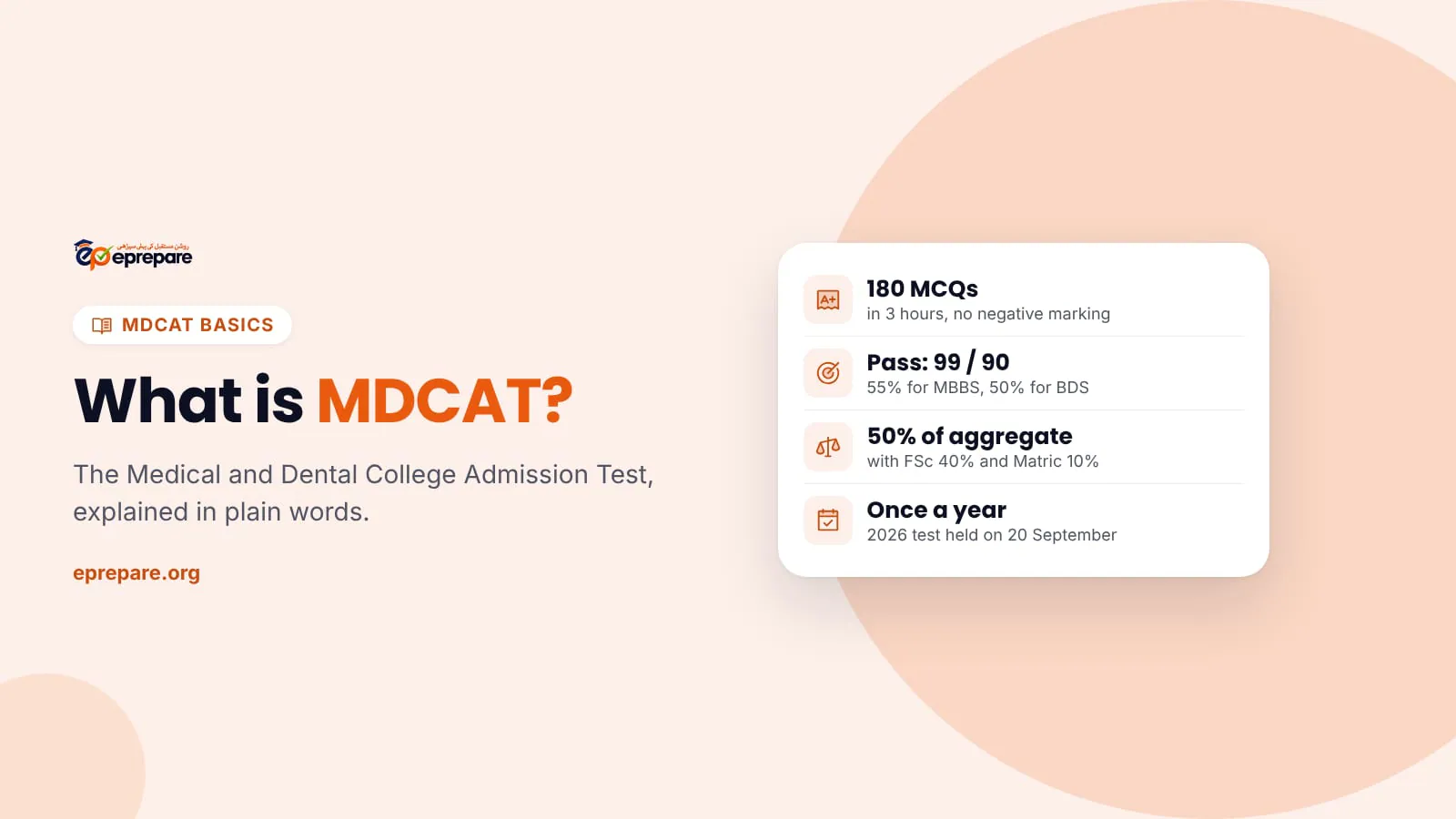
The short answer: MDCAT stands for Medical and Dental College Admission Test. It is the entry test you must pass for admission to MBBS or BDS in any public or private medical or dental college in Pakistan. PM&DC sets the syllabus and rules, and a nominated university conducts it in each province. The paper has 180 MCQs from the FSc syllabus in 3 hours with no negative marking, and you need at least 55% (99 marks) for MBBS or 50% (90 marks) for BDS.
MDCAT at a glance

| Question | Answer |
|---|---|
| Full form | Medical and Dental College Admission Test |
| What it is for | Admission to MBBS and BDS in public and private colleges |
| Who sets the rules | Pakistan Medical and Dental Council (PM&DC) |
| Who conducts it | A university nominated in each province or region |
| Questions and time | 180 MCQs in 3 hours (about one minute per MCQ) |
| Subjects | Biology 81, Chemistry 45, Physics 36, English 9, Logical Reasoning 9 |
| Level | FSc (intermediate) syllabus, set out in PM&DC's uniform curriculum |
| Difficulty mix | 15% easy, 70% moderate, 15% difficult |
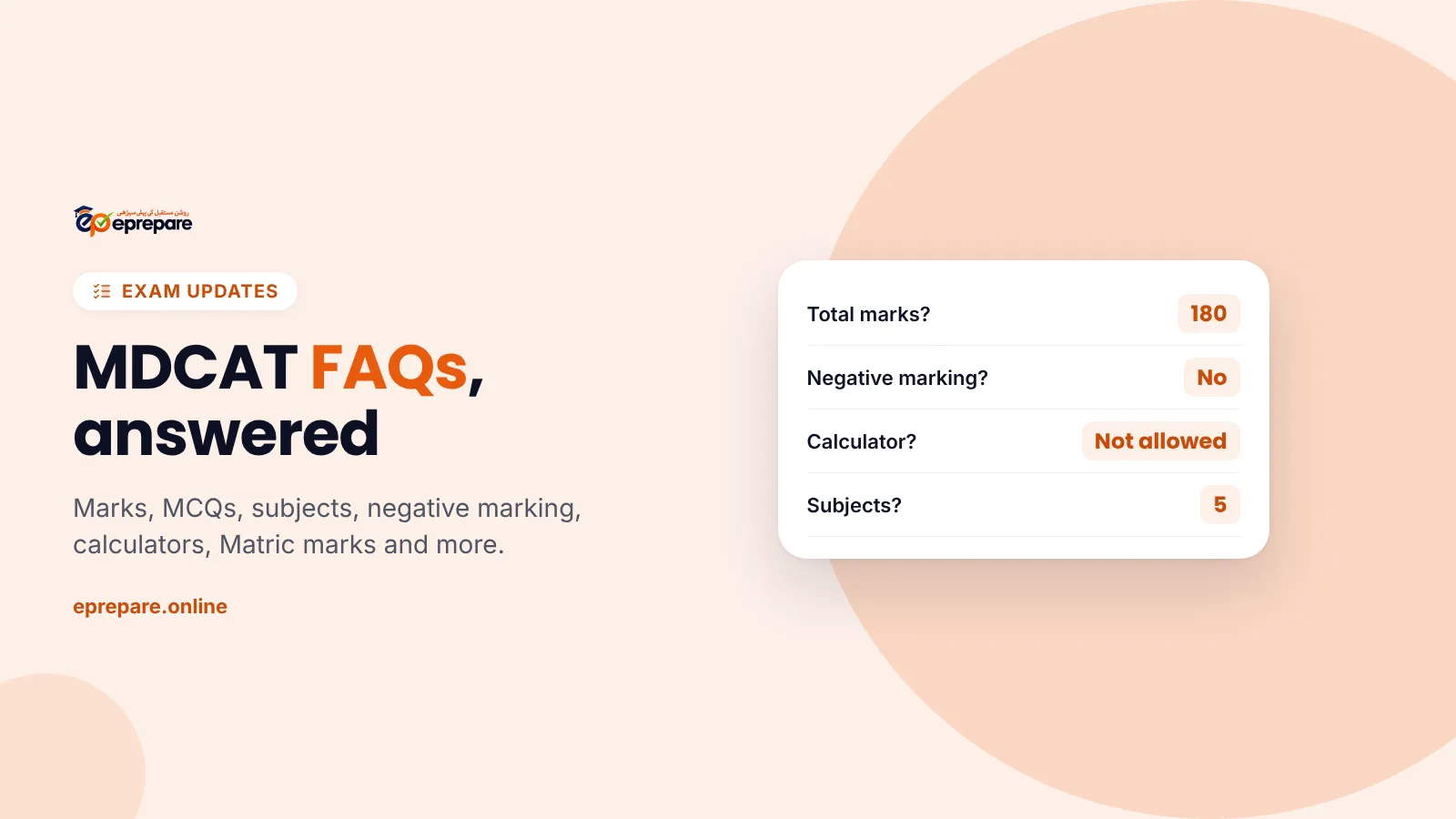
| Negative marking | None |
| Passing marks | 55% (99/180) for MBBS, 50% (90/180) for BDS |
| Validity | Three years, nationwide |
| Share in your aggregate | 50% (FSc 40%, Matric 10%) |
| When it happens | Registration around June–July; in 2026 the test was on 20 September |
What is the full form of MDCAT?
MDCAT stands for Medical and Dental College Admission Test. That is the wording PM&DC uses in its own press releases and notices. Its 2026 regulations use the plural, "Medical and Dental Colleges Admissions Test", for the same test. Students sometimes write "MCAT" for it, but MCAT is a different American test; in Pakistan the test is MDCAT. You will also see "PMDC MDCAT", which simply means the national MDCAT run under PM&DC's rules, to tell it apart from the separate NUMS test.
Who conducts MDCAT?
Two bodies share the job, and it helps to know which does what.
- PM&DC sets the framework. The Pakistan Medical and Dental Council registers candidates, issues one uniform syllabus for the whole country, sets the paper standards and builds a common question bank. For MDCAT 2026, PM&DC said its question bank had about 8,000 questions.
- A university conducts the test in each province. PM&DC's own statement is that "the respective provinces, Gilgit-Baltistan and Islamabad Capital Territory conduct MDCAT", on dates PM&DC approves. The nominated university prints the paper, runs the centres and declares the result.
For MDCAT 2026, PM&DC named these conducting universities:
| Province or region | Conducting university |
|---|---|
| Punjab | University of Health Sciences (UHS), Lahore |
| Sindh | Sukkur IBA University, Sukkur |
| Khyber Pakhtunkhwa (KP) | Khyber Medical University (KMU), Peshawar |
| Balochistan | Bolan University of Medical and Health Sciences (BUMHS), Quetta |
| Islamabad, AJK, Gilgit-Baltistan and Riyadh | Shaheed Zulfiqar Ali Bhutto Medical University (SZABMU), Islamabad |
Each province received at least two separate 180-question papers built from PM&DC's question bank. That is why MDCAT is often called "national" and "provincial" at the same time: one syllabus and one set of rules, but the test is run province by province.
What about NUMS MDCAT?
The National University of Medical Sciences (NUMS) holds its own admission test. PM&DC's 2026 regulations say NUMS is the admitting university for all Armed Forces-administered medical and dental colleges, and that the "NUMS admission test shall be considered only for admission in all Armed Forces Administered medical / dental colleges". NUMS's paper is different too: 150 subject MCQs plus a psychological test, and no Logical Reasoning. If you want both kinds of colleges, you sit both tests. Our PMDC MDCAT vs NUMS MDCAT comparison goes through every difference.
How big is MDCAT in Pakistan?
It is the largest admission test in the country. PM&DC reported 140,071 candidates registered for MDCAT 2025, for about 22,000 MBBS and BDS seats in public and private colleges. For MDCAT 2026, it reported 138,158 registered candidates, tested in 34 cities and towns in Pakistan and one international centre in Riyadh, Saudi Arabia. In 2025 that was more than six registered candidates for every seat, which is why your aggregate, not just a pass, decides where you study.
Who can take MDCAT? (eligibility)
MDCAT is meant for students of FSc Pre-Medical or an equivalent qualification, including those still waiting for their result; each year's registration notice gives the exact conditions. Taking the test and being eligible for admission are two separate steps. PM&DC's 2026 regulations say that to be eligible for an open-merit seat you must:
- Pass the MDCAT.
- Have HSSC (FSc) or an equivalent 12th-grade qualification with at least 60% marks, or a higher percentage if PM&DC notifies one.
- Have passed Biology and Chemistry, with either Physics or Mathematics.
Admitting universities can ask for more. KMU, for example, asks for at least 65% in FSc for KP's public colleges. O and A level students use IBCC equivalence. The details for KP are in our guide to KMU MBBS and BDS eligibility.
What does the MDCAT paper look like?
PM&DC announced the current structure with its revised syllabus in June 2025: 180 multiple-choice questions in three hours, 15% easy, 70% moderate and 15% difficult, with no negative marking. MDCAT 2026 followed the same pattern. The 180 MCQs are split across five subjects:
| Subject | MCQs | Share | Aggregate points (approx.) |
|---|---|---|---|
| Biology | 81 | 45% | 22.5 |
| Chemistry | 45 | 25% | 12.5 |
| Physics | 36 | 20% | 10.0 |
| English | 9 | 5% | 2.5 |
| Logical Reasoning | 9 | 5% | 2.5 |
| Total | 180 | 100% | 50 |

Each MCQ carries one mark, so the paper is out of 180, and three hours for 180 questions gives you about one minute per MCQ. Read the MDCAT paper pattern for a time plan, and MDCAT chapter-wise weightage to see which chapters carry the most questions.
No negative marking means no blanks. A wrong answer and an empty answer both score zero, so always mark your best choice. See is there negative marking in MDCAT.
What does the MDCAT syllabus cover?
MDCAT is built on what you study in FSc Pre-Medical (first and second year). PM&DC publishes one uniform curriculum for the whole country, listing every unit, topic and learning outcome that can be asked. Nothing beyond intermediate level is expected, but the questions test whether you understand the topic, not only whether you remember a line.
- Biology: cell structure, biological molecules, enzymes, bioenergetics, viruses, the human body systems (digestion, respiration, circulation, immunity, homeostasis, support and movement, coordination, reproduction), inheritance, evolution and biotechnology.
- Chemistry: fundamental concepts, atomic structure, gases, liquids and solids, equilibrium, kinetics, thermochemistry, electrochemistry, bonding, s-, p- and transition elements, and organic chemistry from hydrocarbons to carboxylic acids, macromolecules and industrial chemistry.
- Physics: vectors, force and motion, work and energy, circular motion, fluid dynamics, waves and SHM, thermodynamics, electrostatics, current electricity, electromagnetism and induction, alternating current, electronics, and modern, atomic and nuclear physics, with short numericals you solve without a calculator.
- English: reading and thinking skills, grammar and vocabulary ("formal and lexical aspects of language") and writing skills.
- Logical Reasoning: critical thinking, letter and symbol series, logical deductions, logical problems, course of action, and cause and effect: questions that need thinking rather than memory.
Some textbook topics are not in the MDCAT syllabus at all, and NUMS has a few units PMDC MDCAT does not. Our MDCAT syllabus page lists every unit and topic and lets you download the 25-page PDF with every learning outcome; the MDCAT syllabus, subject by subject explains it in detail.

How difficult is MDCAT?
The honest answer has two parts: passing is within reach for most prepared students, but a government MBBS seat is hard.
- The paper is designed to be mostly moderate. PM&DC's 15/70/15 rule means about 27 easy, 126 moderate and 27 difficult MCQs in a 180-question paper.
- Most candidates pass. In UHS's MDCAT 2026 result for Punjab (as reported by TechJuice), 47,475 candidates appeared and 37,708 of them, 79.43%, reached the 55% needed for MBBS. 85.22% reached the 50% needed for BDS.
- Few reach the top. In the same result, only 3.73% scored 170 or more out of 180, and 14.07% scored 160 to 169. In 2025-26 the 17 Punjab public MBBS colleges closed between 93.51% and 94.87% aggregate, which usually needs an MDCAT score in the 170s.
What makes it hard is speed (one minute per MCQ), close answer options, the breadth of five subjects and the competition for seats. What makes it manageable is an FSc-level syllabus, no negative marking and a pattern that does not change. Our full answer, with a worked example of the score you need, is in is MDCAT easy or difficult.
How many marks do you need to pass MDCAT?
PM&DC's minimum is 55% for medical colleges and 50% for dental colleges. On a 180-mark paper that is 99 marks for MBBS and 90 for BDS. Passing makes you eligible to apply. It does not guarantee a seat: a government MBBS seat needs a far higher score. Our MDCAT passing marks guide shows the difference with real closing merit.
How long is an MDCAT result valid?
PM&DC has said the MDCAT score "will be valid nationwide, and will remain valid for three years". So a result from one province can be used for admission in another, and a score can be used in later admission years within that window. Each admitting university lists the MDCAT years it accepts in its own notice. If you want a better score, you can sit MDCAT again in a later year; see the MDCAT repeaters guide.
When is MDCAT? The MDCAT year, step by step
MDCAT is held once a year. PM&DC announces the exact dates each year, and they often move, but the order is always the same.

| Stage | Usually | What happened in 2026 |
|---|---|---|
| PM&DC notice and registration | Around June–July | Registration ran from 22 June to 8 July, with a late fee until 13 July. The fee was PKR 9,000 (PKR 13,000 late) for centres in Pakistan. |
| Admit card and test day | August to October | First set for 16 August, then held on 20 September 2026 |
| Result | Days to weeks after the test | UHS declared Punjab's result on 24 September 2026 |
| Admission applications and merit lists | The following months, in several rounds | Each admitting university opens its portal and displays merit lists |
Every MDCAT from 2023 to 2026 was held between 10 September and 26 October, and the first announced date moved later in three of those four years. For MDCAT 2027, no date has been announced; follow MDCAT date and registration, which we update when PM&DC's notice is out, and prepare as if the test could come earlier.
How MDCAT leads to admission
Your MDCAT score is not used alone. It becomes half of an aggregate, and the merit lists rank students by that aggregate.

- Register on PM&DC's MDCAT portal when registration opens.
- Sit the test at a centre run by your province's conducting university.
- Get your result from that university.
- Apply for admission to the admitting university for your province (for example KMU for KP's public colleges), or to NUMS for Armed Forces colleges with the NUMS test.
- Your aggregate is calculated as MDCAT 50%, FSc 40% and Matric 10%, the weighting PM&DC's regulations set for both public and private colleges.
- Merit lists are displayed, at least three for public colleges under PM&DC's regulations, and students are admitted and upgraded by merit and preference.
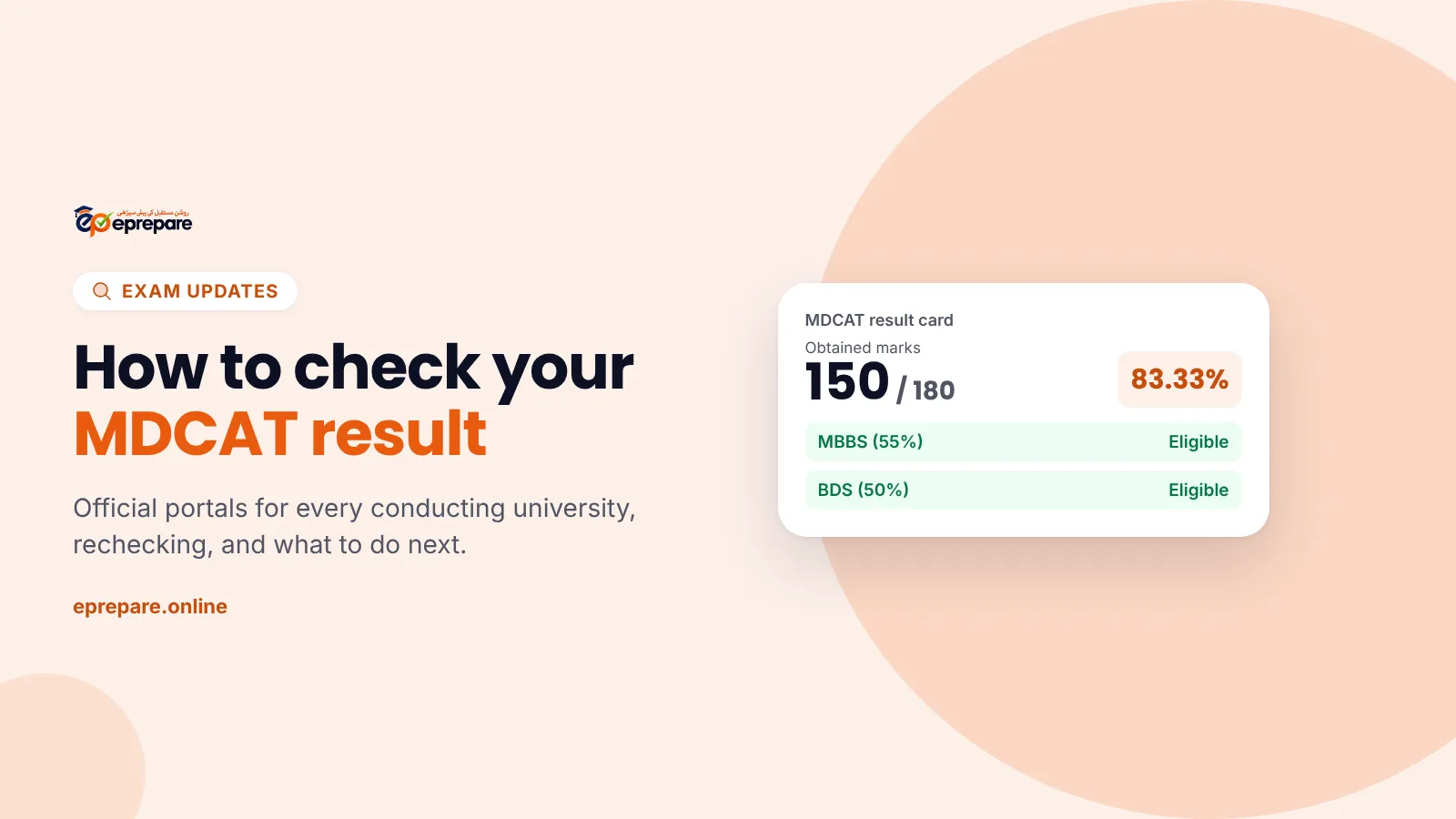
Every MDCAT mark adds about 0.278 to your aggregate. For example, 150 out of 180 gives you 150 ÷ 180 × 50 ≈ 41.7 aggregate points from MDCAT. Our guide on how to calculate MDCAT aggregate works it out for every university, and the merit calculator does the sum for you.
In Urdu: MDCAT in short
In Urdu
ایم ڈی کیٹ (MDCAT) کا پورا نام میڈیکل اینڈ ڈینٹل کالج ایڈمیشن ٹیسٹ ہے۔ پاکستان کے ہر سرکاری اور پرائیویٹ میڈیکل اور ڈینٹل کالج میں داخلے کے لیے یہ ٹیسٹ پاس کرنا ضروری ہے۔
پی ایم اینڈ ڈی سی سلیبس اور قواعد طے کرتی ہے، اور ٹیسٹ ہر صوبے کی نامزد یونیورسٹی لیتی ہے۔ آرمڈ فورسز کے کالجوں کے لیے نمز (NUMS) اپنا الگ ٹیسٹ لیتی ہے۔
پرچے میں 180 MCQs ہوتے ہیں: Biology کے 81، Chemistry کے 45، Physics کے 36، English کے 9 اور Logical Reasoning کے 9۔ وقت 3 گھنٹے ہے، یعنی تقریباً ایک منٹ فی سوال، اور منفی مارکنگ نہیں ہے۔ سلیبس FSc لیول کا ہے۔
MBBS کے لیے کم از کم 55 فیصد (99 نمبر) اور BDS کے لیے 50 فیصد (90 نمبر) چاہییں۔ پاس کرنا زیادہ تر تیار طلبہ کے لیے ممکن ہے، لیکن سرکاری MBBS سیٹ کے لیے عموماً 170 سے اوپر نمبر چاہییں۔
رجسٹریشن عموماً جون جولائی میں ہوتی ہے؛ 2026 میں ٹیسٹ 20 ستمبر کو ہوا۔ داخلہ میرٹ پر ہوتا ہے: میٹرک 10 فیصد، FSc 40 فیصد اور MDCAT 50 فیصد۔ نتیجہ تین سال تک پورے ملک میں قابلِ قبول ہے۔
How to start preparing for MDCAT
Now that you know what MDCAT is, the next question is what to do on day one. Keep it simple:
- Start from the official syllabus, not a guess. Mark the chapters you already know from FSc.
- Take a short baseline test in each subject, so you know where you stand before you plan.
- Make a day-by-day plan to the exam, and give Biology the most time: it is 81 of the 180 marks.
- Learn each chapter, then practise its MCQs the same day, and save every MCQ you get wrong for revision.
- Test yourself weekly, then move to full 180-MCQ papers under a 3-hour timer.
- Use past papers to learn the style of questions: see MDCAT past papers.

Our step-by-step guide how to start studying for MDCAT turns this into a 14-day starter plan, and the MDCAT preparation guide has plans for 12 months, 6 months, 90 days and 30 days. If you want to prepare online, see what to look for in the best online MDCAT preparation platform. When you are ready, register on ePrepare for lectures, chapter-wise MCQs with English and Urdu explanations, past papers and full-length papers in the real 180-MCQ pattern.
Frequently asked questions
What is MDCAT?
MDCAT is the Medical and Dental College Admission Test, the compulsory entry test for MBBS and BDS admission in all public and private medical and dental colleges in Pakistan.
What is the MDCAT test made of?
180 MCQs in 3 hours: Biology 81, Chemistry 45, Physics 36, English 9 and Logical Reasoning 9. Each MCQ is one mark, there is no negative marking, and the difficulty is 15% easy, 70% moderate and 15% difficult.
Who conducts MDCAT in Pakistan?
PM&DC sets the syllabus, standards and question bank, and a nominated university conducts the test in each province. In 2026 these were UHS (Punjab), Sukkur IBA University (Sindh), KMU (KP), BUMHS (Balochistan) and SZABMU (Islamabad, AJK, Gilgit-Baltistan and Riyadh). NUMS holds a separate test for Armed Forces colleges.
What are the passing marks of MDCAT?
55% (99 out of 180) for MBBS and 50% (90 out of 180) for BDS. A government MBBS seat needs much more: Punjab's public MBBS colleges closed between 93.51% and 94.87% aggregate in 2025-26.
Is MDCAT difficult?
Passing is achievable for most prepared students: 79.43% of candidates in UHS's 2026 result reached 55%. Scoring high enough for a government MBBS seat is hard: only 3.73% scored 170 or more. See is MDCAT easy or difficult.
When is MDCAT held every year?
Once a year. Registration usually opens around June–July, and every MDCAT from 2023 to 2026 was held between September and October; MDCAT 2026 was on 20 September. PM&DC announces each year's dates in its notice.
Is MDCAT based on the FSc syllabus?
Yes. PM&DC's uniform curriculum follows the FSc Pre-Medical (intermediate) level, plus English and Logical Reasoning. Some textbook topics are left out; the MDCAT syllabus page lists exactly what is in and out.
Can I take MDCAT after FSc Pre-Medical?
Yes. MDCAT is for FSc Pre-Medical or equivalent students, including those awaiting their result. For admission you also need at least 60% in HSSC with Biology and Chemistry, plus Physics or Mathematics.
How many times can I take MDCAT?
PM&DC holds MDCAT once a year, and many students sit it again to improve their score. Because a result stays valid for three years, check which year's score the admitting university will use in its notice.
What is MDCAT in Urdu?
In Urdu it is written ایم ڈی کیٹ: the medical and dental college admission test that every student must pass to get admission to MBBS or BDS in Pakistan. The Urdu summary above has the key facts.
Is MDCAT the same as MCAT?
No. MCAT is a test in the USA. Pakistan's medical entry test is MDCAT, although PM&DC's regulations accept a foreign MCAT for some foreign and overseas seats.
Sources: PM&DC press release: MDCAT rescheduled to 20 September 2026; PM&DC press release, 16 September 2026 (conducting universities, question bank); PM&DC press release, 18 September 2026 (who conducts MDCAT, registered candidates); PM&DC: new syllabus for MDCAT 2025 (pattern, difficulty, passing marks); PM&DC press release, 22 October 2025 (seats, three-year validity); PM&DC: over 140,000 candidates register for MDCAT 2025; PM&DC admissions, curriculum and conduct regulations 2026; PM&DC uniform MDCAT curriculum; UHS's MDCAT 2026 result (as reported by TechJuice); UHS final open-merit list 2025-26 (closing merit).