

If you are studying A Levels and preparing for MDCAT, do not assume that a familiar chapter title means you have covered every PM&DC learning outcome. Map each outcome to evidence from your own course, test your understanding with fresh questions, and spend your MDCAT study time on outcomes that are incomplete or uncertain.
Check the syllabus status first. On 14 November 2026, PM&DC's Syllabi page listed the finalized MDCAT-2025 curriculum as its latest MDCAT syllabus. PM&DC's notice for the 2026 test said that curriculum would apply to MDCAT 2026. That notice does not confirm which syllabus will apply in 2027. Use the latest official document as your working reference and check PM&DC again when the 2027 notice is published. Check the PM&DC syllabus page and the official 2026 notice.
Why A-Level students need a syllabus map
A Levels build subject knowledge and analytical skills, but MDCAT is set against PM&DC's own curriculum and learning outcomes. Your awarding body, subject choices, syllabus code and examination session also matter. Cambridge International, Pearson Edexcel and other qualifications do not use one interchangeable A-Level syllabus.
Two shortcuts can waste your time. You might repeat an entire subject you already understand, or mark a topic complete because its name looks familiar while missing a specific definition, process, diagram or application in the PM&DC outcomes.
Map the exact outcome to evidence from your A-Level course, then check whether you can retrieve and apply it without looking at your notes. This guide shows how to do that without turning your MDCAT preparation into a second full A-Level course.
Collect the right syllabus documents
- Download the latest MDCAT curriculum listed by PM&DC. Save the source URL and the date you checked it.
- For each A-Level subject, write down the awarding body, subject name, syllabus code and examination session. Use the specification that matches your exams, not a generic “A-Level Biology” checklist.
- Keep your course notes or textbook nearby. They help you locate evidence, but the PM&DC outcomes are the checklist for this MDCAT mapping exercise.
Cambridge International publishes syllabus documents by subject code and examination year. Its Biology 9700 page also links to syllabus updates. If you take another board, check that board's current subject specification. Cambridge International Biology 9700 syllabus and updates.
Map outcomes, not chapter names
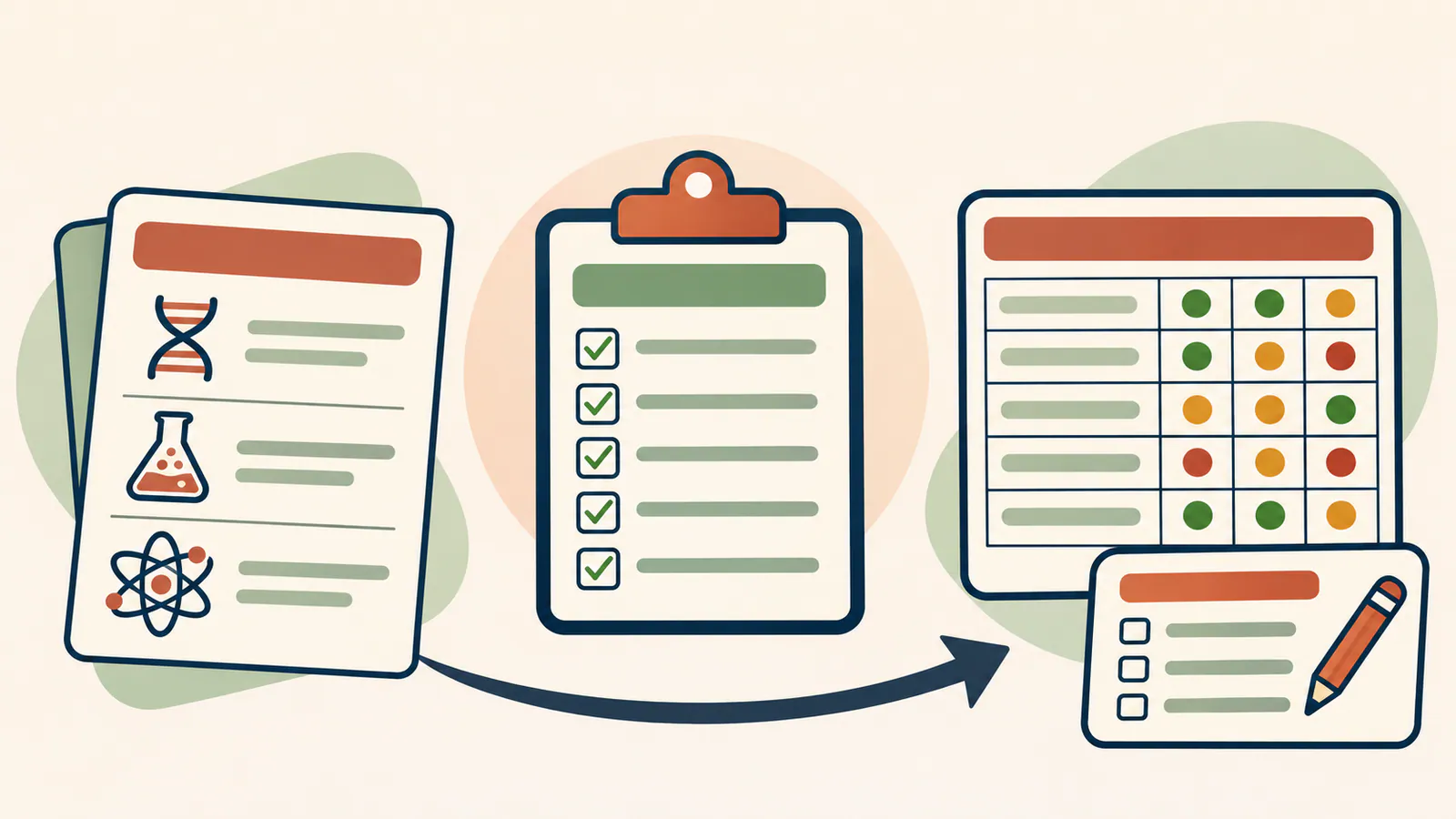
Write one row for each PM&DC learning outcome. Record the exact evidence in your A-Level syllabus, how you tested it and what you will do next. A spreadsheet or notebook is enough.
| PM&DC outcome | Evidence in my A-Level course | My check | Next action |
|---|---|---|---|
| Copy the unit and outcome number | Board, subject code, topic and lesson or page | Explain it from memory and answer fresh questions | Ready, practise, or learn the missing part |
Use four plain statuses:
- Ready: You can explain the outcome without notes and handle a new question on it.
- Needs practice: The idea is familiar, but you hesitate, guess or miss questions when the wording changes.
- Partial: You know some parts but cannot explain the full process or every detail in the outcome.
- Not covered: You cannot find it in your course evidence or cannot yet explain it.
These labels are a planning tool, not an official score or a prediction of what will appear on the test. If you are unsure whether a topic is in scope, check the latest PM&DC document or ask a teacher before adding it to your MDCAT workload.
Worked example: the cardiac cycle
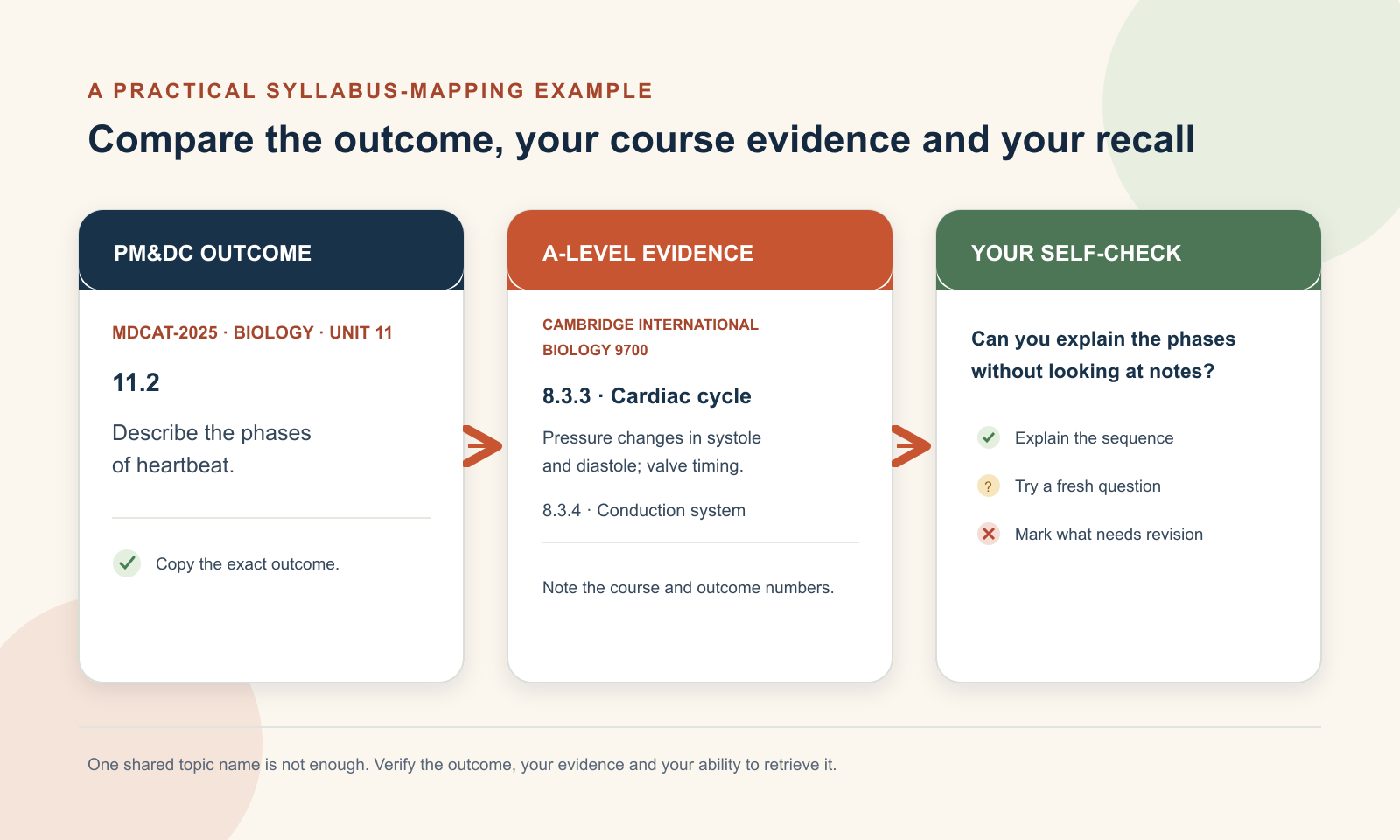
The PM&DC-2025 Biology curriculum lists “Describe the phases of heartbeat” as outcome 11.2 under Circulation. Cambridge International Biology 9700 goes into more detail in its heart outcomes: outcome 8.3.3 includes pressure changes and valve timing, and 8.3.4 covers the conduction system.
Do not mark outcome 11.2 ready just because both documents contain the words “cardiac cycle.” Close your notes and describe the phases in order. Then answer a few new topic questions and explain why each answer follows. If you can recall the sequence but struggle when it appears in a diagram or a differently worded question, mark it Needs practice. If you cannot describe the phases, mark it Partial or Not covered and schedule a short review.
This example shows why matching topic names is only the start. Check the whole PM&DC unit and your exact A-Level syllabus code before marking anything ready. An outcome in your A-Level notes can still need MDCAT-style practice.
Turn the map into a focused study week
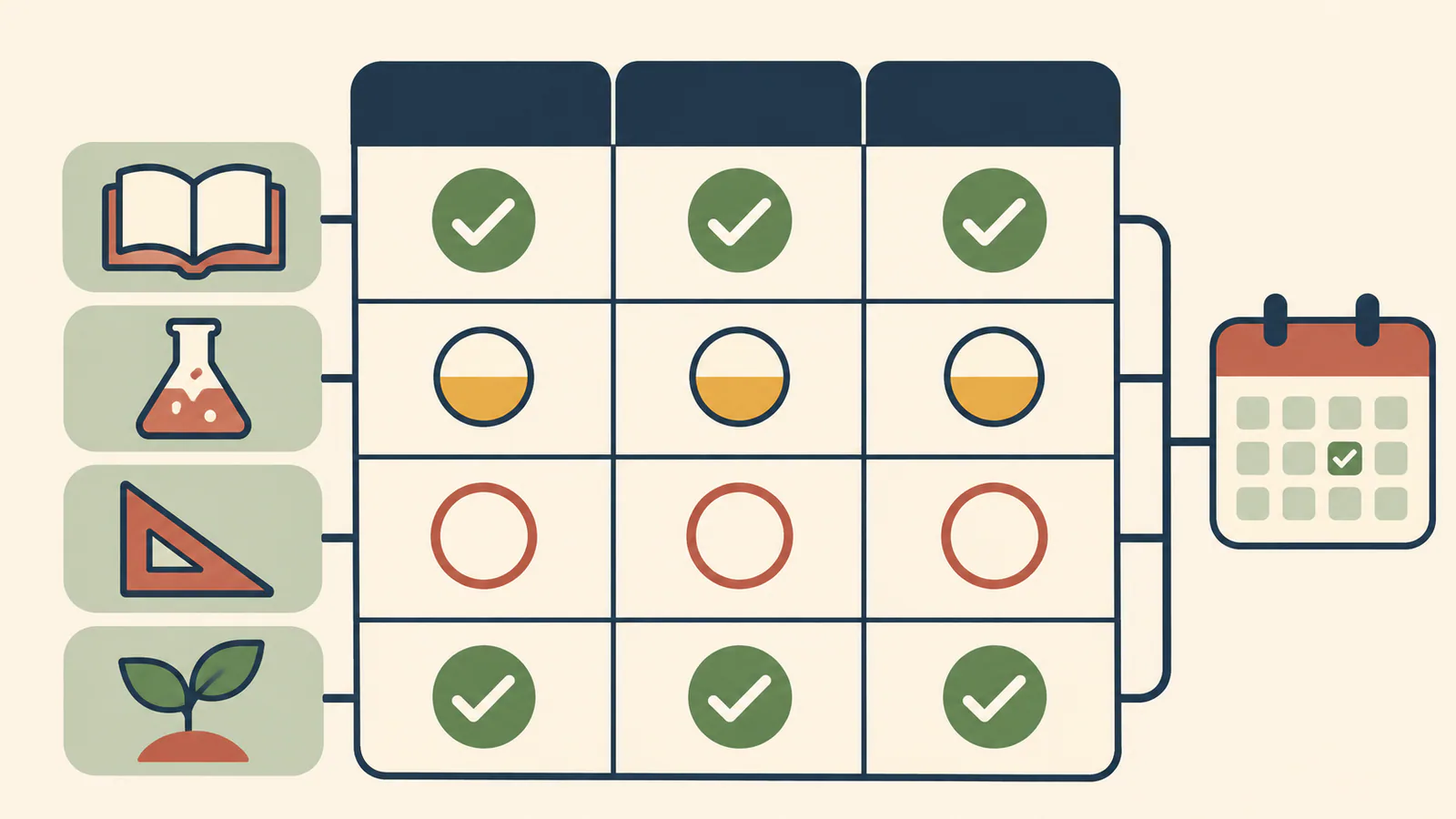
Each week, choose a manageable set of outcomes marked Not covered, Partial or Needs practice. Start with the weakest outcomes and the subjects where your diagnostic questions show the clearest gaps. Keep ready outcomes in a short review rotation.
- Retrieve: Spend a few minutes explaining the outcome from memory or sketching its process.
- Fill the exact gap: Revisit the relevant lesson, textbook section or notes. If the concept is already clear, move to application questions instead of replaying a whole course.
- Practise: Answer a small set of new MDCAT-style questions on that outcome. Read the reasoning for correct answers too, especially when you guessed.
- Update the map: Record what you missed and schedule a short recheck later in the week. Move an outcome to Ready only after you can retrieve and apply it again.
Balance this map with your A-Level classes and exams. Keep the process small enough to repeat. If you have two hours for MDCAT in a week, use the map to choose the most important gaps for those hours rather than trying to redo every A-Level chapter.
Use MCQs to verify coverage, not just count them
A high number of attempted MCQs does not show whether every outcome is covered. When you review a question, note which outcome it tested and why you missed it: missing concept, forgotten detail, misread wording, weak application or a guess. That tells you whether to reread, practise a process or work on question interpretation.
Start with targeted practice while learning an outcome. Later, mix ready and weak outcomes in the same test so you have to identify the relevant idea without a chapter label. ePrepare's topic-wise question bank and Bookline practice can help you test mapped topics. Use your map to choose what to practise.
Update your map when PM&DC publishes the 2027 syllabus
Compare the new PM&DC document with the version you used for your first map. Add newly listed outcomes, update changed wording and remove items PM&DC has removed or revised. Keep the document date beside your map so you know which version it follows.
Do not treat a prediction, social post or last year's test pattern as an official syllabus change. Follow PM&DC's Syllabi page and public announcements, then revise your map when the official 2027 material appears.
Keep MDCAT preparation and admission equivalence separate
This map helps you prepare for the test. A-Level equivalence and admission eligibility are separate administrative steps with their own rules. Check current official instructions, and see ePrepare's A-Level equivalence guide for KMU admissions for that admission-specific process.
Frequently asked questions
Does taking A Levels mean I have already covered the MDCAT syllabus?
Not automatically. Compare your exact A-Level syllabus and subject code with each current PM&DC learning outcome, then test what you can explain and apply.
Should I study the whole FSc textbook from the beginning?
Use the current PM&DC curriculum to decide what MDCAT preparation requires. Map each outcome to evidence you already have, then focus MDCAT study time on incomplete or uncertain outcomes. Keep any separate board or A-Level exam requirements in your own course plan.
Which A-Level syllabus should I use for the comparison?
Use the official syllabus matching your awarding body, subject code and examination session. Cambridge International Biology 9700 is one example; other exam boards have their own specifications.
Is the MDCAT 2027 syllabus confirmed?
Check PM&DC's current Syllabi page and notices. At the time this guide was checked, the page listed MDCAT-2025 as its latest finalized MDCAT syllabus, and PM&DC's 2026 notice applied it to the 2026 test. This does not establish the 2027 syllabus.
Do I use this map for IBCC equivalence?
No. This map is for aligning study outcomes. IBCC equivalence and admission eligibility follow separate official rules. Check current authority instructions before applying.