

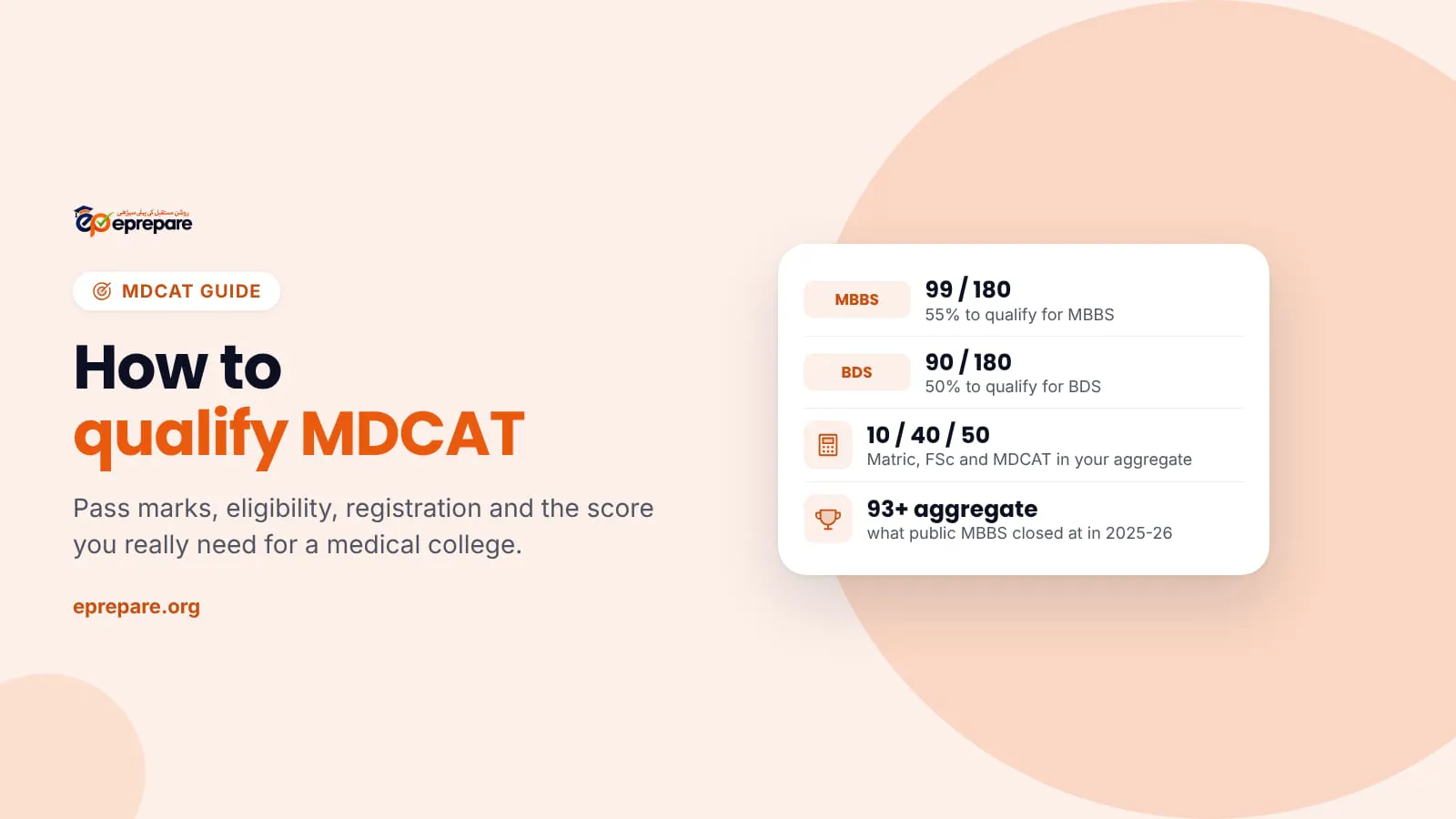
The short answer: to qualify MDCAT you need at least 55% (99 out of 180) for MBBS or 50% (90 out of 180) for BDS, after passing FSc Pre-Medical (or an equivalent) with at least 60% marks. Qualifying only makes you eligible: a public MBBS seat in 2025-26 needed an aggregate of about 93% or more, so aim far above the pass mark.
Every year more than a hundred thousand students sit the MDCAT (Medical and Dental College Admission Test) for MBBS and BDS seats in Pakistan. This guide explains exactly what "qualifying MDCAT" means under the Pakistan Medical and Dental Council (PMDC) rules, who is eligible, how registration works, the marks you need for admission, and practical tips to qualify and score high. Every rule below is taken from PMDC's own regulations, notices and curriculum, linked in the sources at the end.
What does it mean to qualify MDCAT?
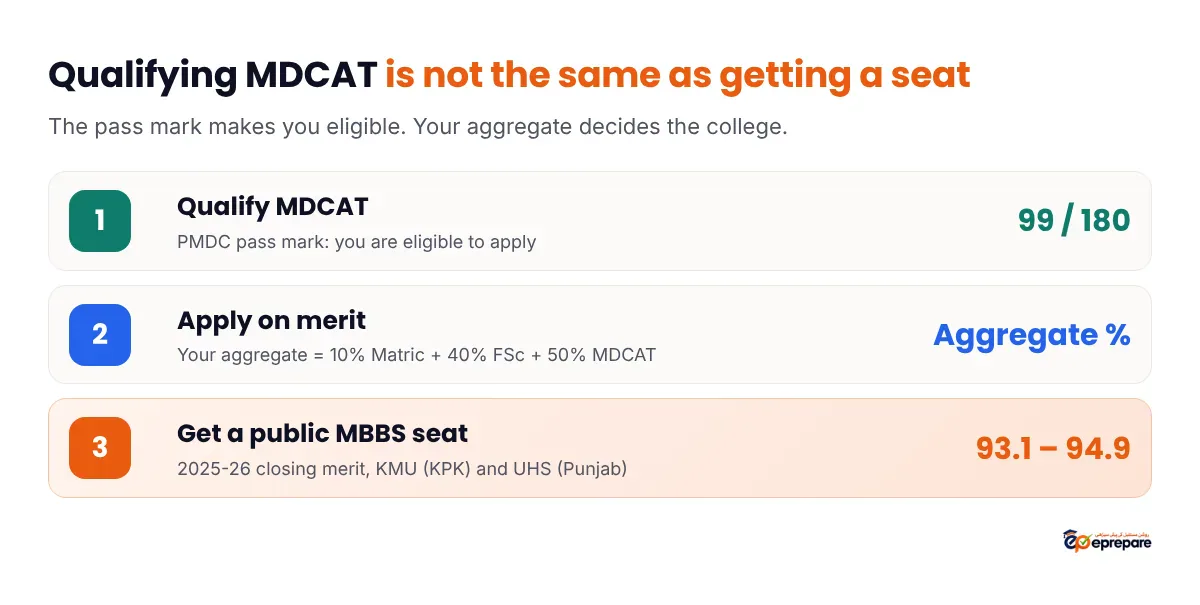
You qualify MDCAT when your score reaches PMDC's minimum pass mark. That makes you eligible to apply for admission to medical and dental colleges anywhere in Pakistan. It does not, by itself, give you a seat: seats are given on merit, which combines your MDCAT score with your Matric (SSC) and FSc (HSSC) marks.
Under the PMDC Act 2022, an MDCAT result taken in any province is valid for the whole country and stays valid for three years. So a result from MDCAT 2026 can be used for admissions in the following sessions too.
MDCAT passing marks for MBBS and BDS
| Programme | Pass percentage | Minimum marks out of 180 |
|---|---|---|
| MBBS (medical colleges) | 55% | 99 |
| BDS (dental colleges) | 50% | 90 |
These pass marks are set in PMDC's MDCAT curriculum and are the same for every province, every board and every MDCAT centre. For the 2025-26 session only, PMDC allowed a one-time 3% relaxation (52% MBBS, 47% BDS) to fill seats left vacant; it does not apply to new sessions. Read more in our MDCAT passing marks guide.
Who is eligible for MDCAT and medical college admission?
PMDC's Admissions, Curriculum and Conduct Policy and Regulations 2026 set the eligibility for MBBS and BDS admission. A candidate must:
- Pass the MDCAT with the minimum pass mark above.
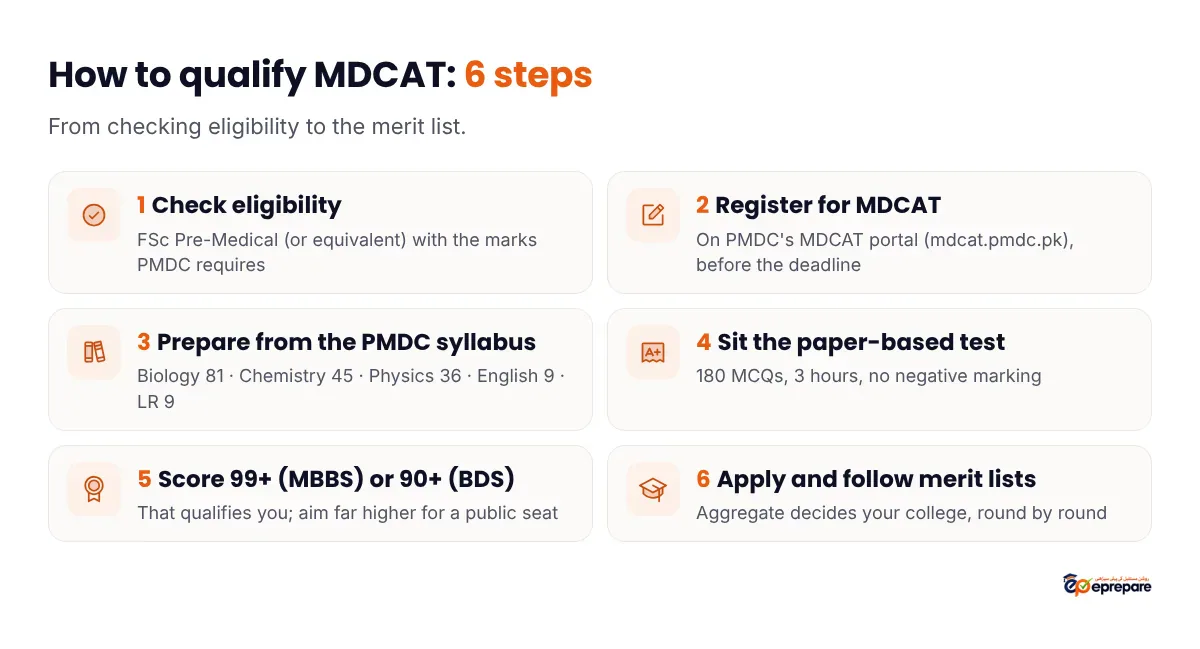
- Pass FSc Pre-Medical (HSSC), or an equivalent 12th-grade qualification recognised in Pakistan, with at least 60% marks, or a higher percentage if PMDC notifies one.
- Have passed Biology and Chemistry, which are compulsory, plus either Physics or Mathematics.
- Hold an IBCC equivalence certificate if you studied A-Levels or a foreign 12th-grade system. Admitting universities such as UHS and NUMS require it.
The regulations set no age limit and no limit on the number of MDCAT attempts, so repeaters can sit the test again; see our MDCAT repeaters guide. You can register for MDCAT while your FSc result is awaited, but you must meet the FSc requirement by the time you apply for admission.
KPK students: KMU's eligibility page has listed 65% FSc while PMDC's 2026 regulations say 60%. Check KMU's admission notice for your session before you apply. Our KMU MBBS and BDS eligibility guide explains KMU's rules in detail.
How to register for MDCAT
For MDCAT 2026, PMDC ran registration itself on its online portal, mdcat.pmdc.pk. The process takes about fifteen minutes if your documents are ready.
- Watch PMDC's public notice for the registration dates. In 2026 the portal opened on 22 June, with the regular deadline extended to 13 July and a late-fee window after it.
- Create an account on the PMDC MDCAT portal with your CNIC or B-Form number, mobile number and email.
- Fill in your details: Matric and FSc marks (or "result awaited"), domicile and a recent photograph.
- Choose your test centre in your own province. PMDC lets candidates sit MDCAT only in the province or region of their domicile. Riyadh, Saudi Arabia, is the only international centre.
- Pay the fee. For MDCAT 2026 it was PKR 9,000 in Pakistan (PKR 13,000 with the late fee).
- Download your admit card before the test and check your roll number, centre and timing.
For the latest dates for the coming session, follow our MDCAT date and registration guide.
Which university conducts MDCAT in your province?
PMDC sets the rules, the syllabus and the pass marks. A university in each province prints the paper, runs the test centres and announces the MDCAT result.
| Province / region | Conducting university |
|---|---|
| Punjab | University of Health Sciences (UHS), Lahore |
| Sindh | Sukkur IBA University |
| Khyber Pakhtunkhwa | Khyber Medical University (KMU), Peshawar |
| Balochistan | Bolan University of Medical and Health Sciences (BUMHS), Quetta |
| Islamabad, AJK, Gilgit-Baltistan and Riyadh | Shaheed Zulfiqar Ali Bhutto Medical University (SZABMU), Islamabad |
Each province gets its own question paper, all set from the same PMDC syllabus. Your result is then valid across Pakistan.
MDCAT paper pattern: what you have to pass
The MDCAT is a paper-based test of 180 MCQs in 3 hours, with no negative marking. The questions come from PMDC's uniform curriculum, which is the same for MDCAT 2025, 2026 and 2027.
| Subject | MCQs | Share |
|---|---|---|
| Biology | 81 | 45% |
| Chemistry | 45 | 25% |
| Physics | 36 | 20% |
| English | 9 | 5% |
| Logical Reasoning | 9 | 5% |
| Total | 180 | 100% |
Download the full chapter-wise list in our MDCAT syllabus PDF, and see how questions are set in the MDCAT paper pattern guide.
Qualifying vs getting admission: the marks you really need
Passing with 99 makes you eligible, but medical colleges fill their seats in order of aggregate. PMDC's regulations fix the aggregate for public and private colleges as:
Aggregate = 10% Matric (SSC) + 40% FSc (HSSC) + 50% MDCAT
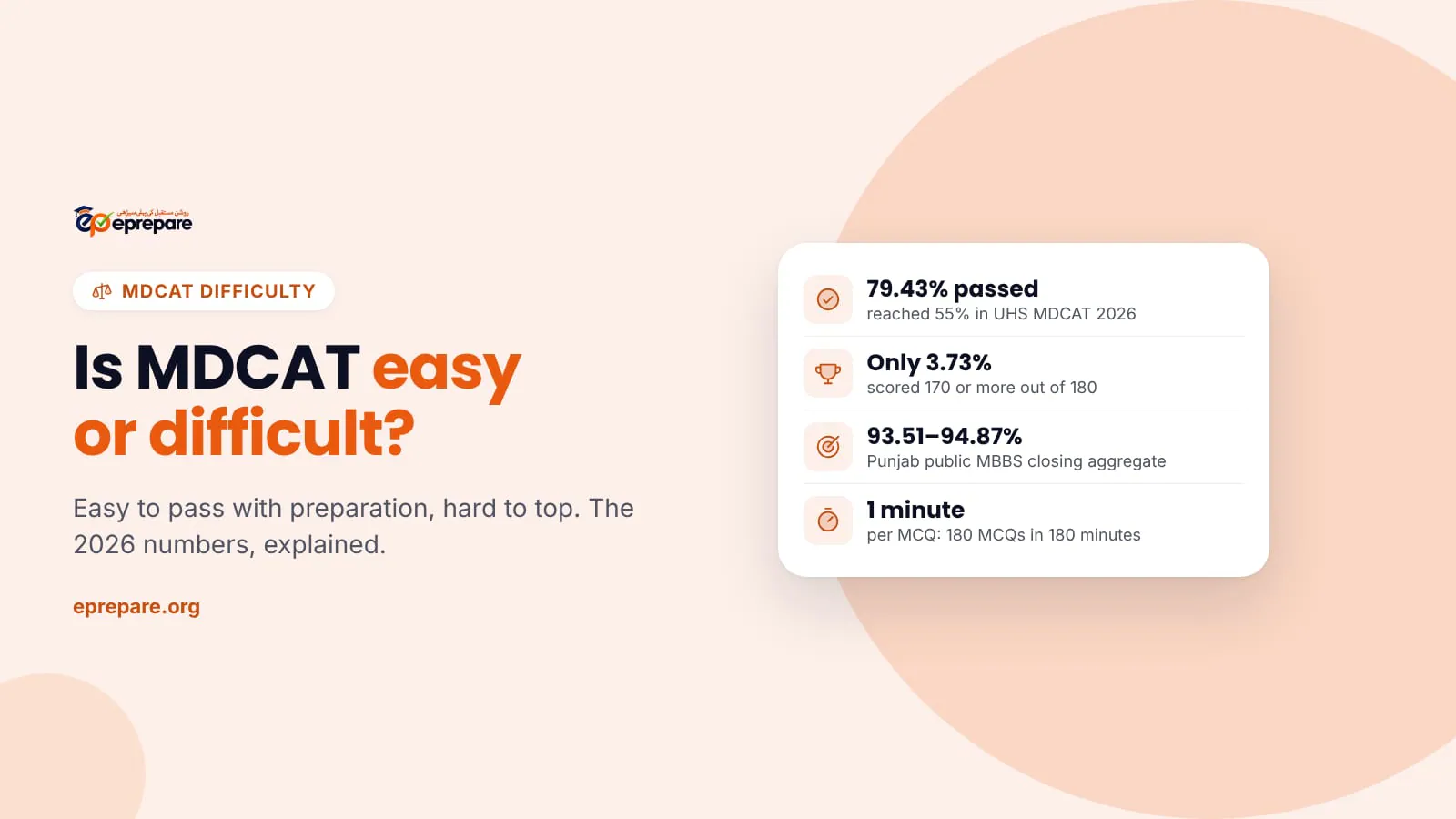
Because so many students apply for so few public seats, the closing merit is far above the pass mark. In session 2025-26, public MBBS colleges closed at these aggregates:
| Admitting university | Highest closing | Lowest closing |
|---|---|---|
| KMU (Khyber Pakhtunkhwa) | 94.77% (Khyber Medical College) | 93.11% (KIMS Kohat) |
| UHS (Punjab) | 94.87% (King Edward Medical University) | 93.51% |
So how many MDCAT marks do you need? It depends on your Matric and FSc. The table shows the MDCAT score needed for each target aggregate:
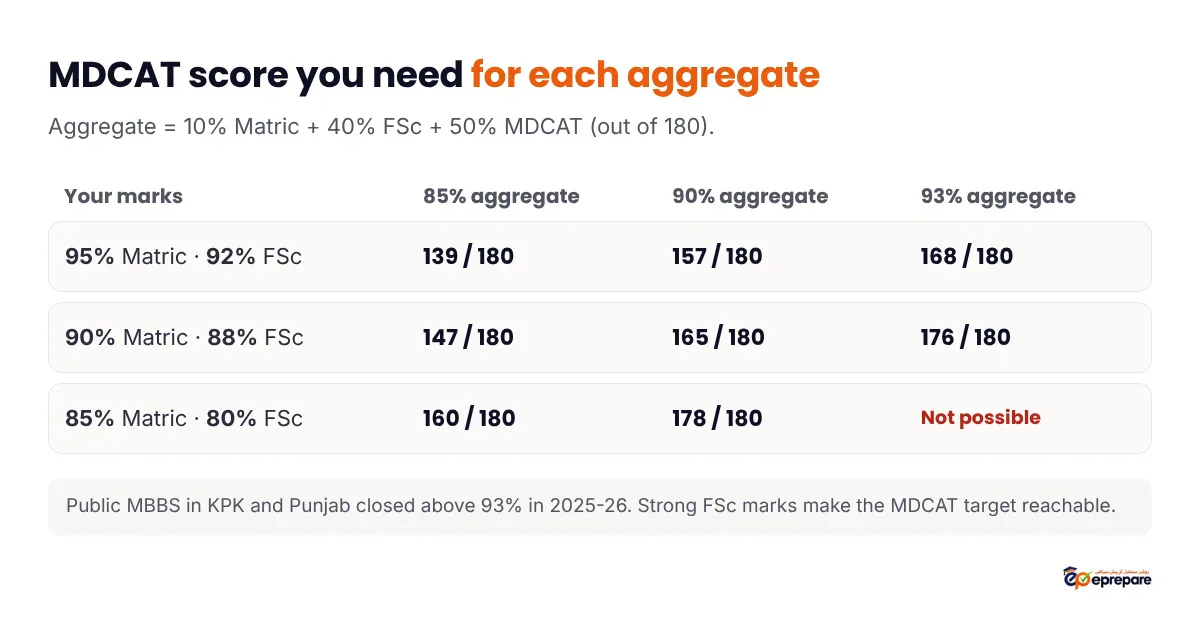
Work out your own numbers with the MDCAT merit calculator, compare them with every college on the MDCAT closing merit page, or see which colleges fit your aggregate with the college predictor. For a full walk-through of the formula, read how to calculate your MDCAT aggregate.
NUMS MDCAT: a separate route
The National University of Medical Sciences (NUMS) is the admitting university for the armed forces medical and dental colleges, such as Army Medical College and the CMH colleges. Under PMDC's 2026 regulations, the NUMS admission test counts only for those armed forces colleges. NUMS has its own MDCAT with the same pass marks (55% MBBS, 50% BDS), the same 60% FSc minimum and the same 10/40/50 merit formula. If you want both routes, register for both tests. Compare them in our PMDC MDCAT vs NUMS MDCAT guide.
MDCAT result and admission deadlines
Each conducting university announces its province's MDCAT result on its website a few days after the test, and you can usually see your score with your roll number or CNIC. After the result, admitting universities (KMU, UHS, the Sindh universities, the Balochistan selection committee, SZABMU and NUMS) open their admission portals.
PMDC's regulations set these last dates for admissions each year, unless PMDC notifies otherwise:
| Colleges | Last date |
|---|---|
| Public medical colleges | 31 December |
| Private medical colleges | 31 January |
| Public dental colleges | 15 February |
| Private dental colleges | 28 February |
MDCAT 2027: what to expect
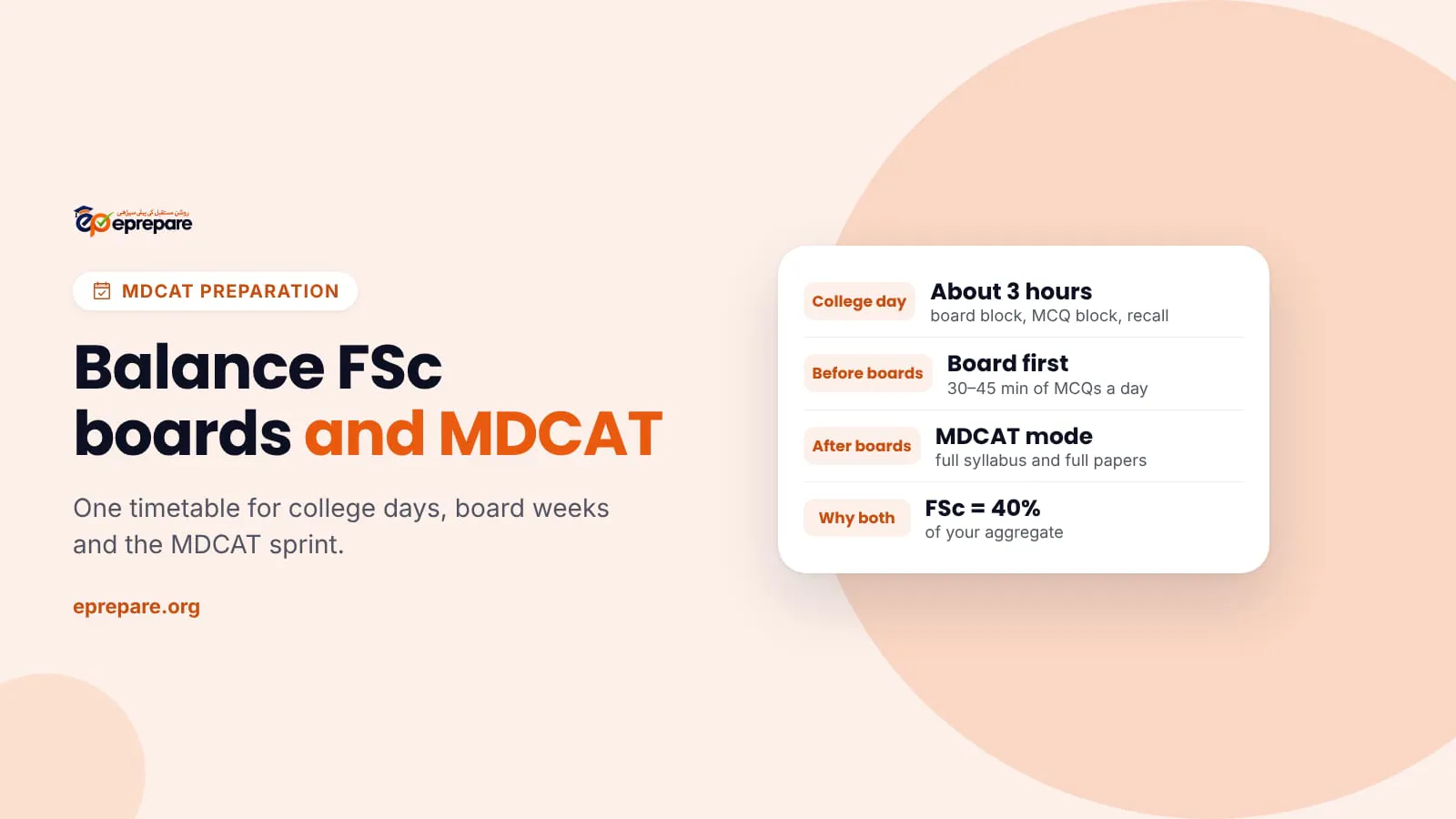
MDCAT 2027 follows the same PMDC syllabus and 180-MCQ pattern. PMDC has not announced the 2027 date yet, but the federal health minister has said the government wants MDCAT held soon after the FSc exams from next year. That could leave far less time between FSc and MDCAT than before, so the safest plan is to prepare for MDCAT alongside your FSc rather than after it.
12 tips to qualify MDCAT and score high
These tips come from what our top scorers did differently. None of them need an expensive academy: they need a plan, the right practice and honest revision.
1. Study from the PMDC syllabus, not from the whole textbook
The paper is set from PMDC's 61 units and their learning outcomes. Print the MDCAT syllabus PDF, keep it beside you and tick each outcome when you can explain it without the book. Anything outside that list costs time and earns no marks.
2. Give Biology the most time
Biology is 81 of 180 MCQs, as many as Chemistry and Physics together. A student who is strong in Biology can qualify on Biology and English alone; a student weak in Biology struggles even with good Physics.
3. Read the textbook line by line for Biology
Many Biology MCQs are lifted from a single line of the FSc book: a definition, a number, an example. Read your board's textbook carefully, and practise line-by-line MCQs such as Bookline MCQs that are written from the textbook text.
4. Practise MCQs every day, from the first week
Reading feels like progress; MCQs show whether it stuck. After every topic you read, solve 30 to 50 MCQs on that topic the same day. Aim for at least 100 MCQs a day once your syllabus is moving.
5. Keep a mistake notebook and revisit it
The questions you get wrong are the most valuable thing you own. Note each one with the reason you missed it (concept, careless, not studied), and revise that list every few days. On ePrepare, the Mistake Diary and smart revision do this for you automatically.
6. Solve Physics and Chemistry numericals by hand
MDCAT numericals are built to be worked out quickly on paper. Practise every numerical by hand from the start, learn the common values, and use estimation to rule out wrong options fast.
7. Don't leave English and Logical Reasoning to the end
They are only 9 MCQs each, but they are the fastest 18 marks in the paper. Fifteen minutes a day of grammar and reasoning questions is enough to make them nearly full marks.
8. Solve past papers in exam conditions
Past papers show how PMDC actually asks each topic. Solve the 2025 and 2026 papers, which use the current syllabus and pattern, timed and in one sitting. Start with our MDCAT past papers.
9. Take full-length tests every week in the last two months
A 180-MCQ, 3-hour paper tests stamina as much as knowledge. Weekly full-length papers build speed, show your weak subjects and remove exam-day nerves. See our guide to MDCAT mock tests and FLPs.
10. Never leave a question blank
There is no negative marking in MDCAT, so a blank answer is a guaranteed zero. Eliminate the options you know are wrong and choose from what is left. Read more about negative marking.
11. Manage your 3 hours
That is one minute per MCQ. Do your strongest subject first, mark hard questions and come back to them, and leave the last ten minutes to fill any gaps on the answer sheet. Our MDCAT time management guide has a minute-by-minute plan.
12. Follow a written study plan
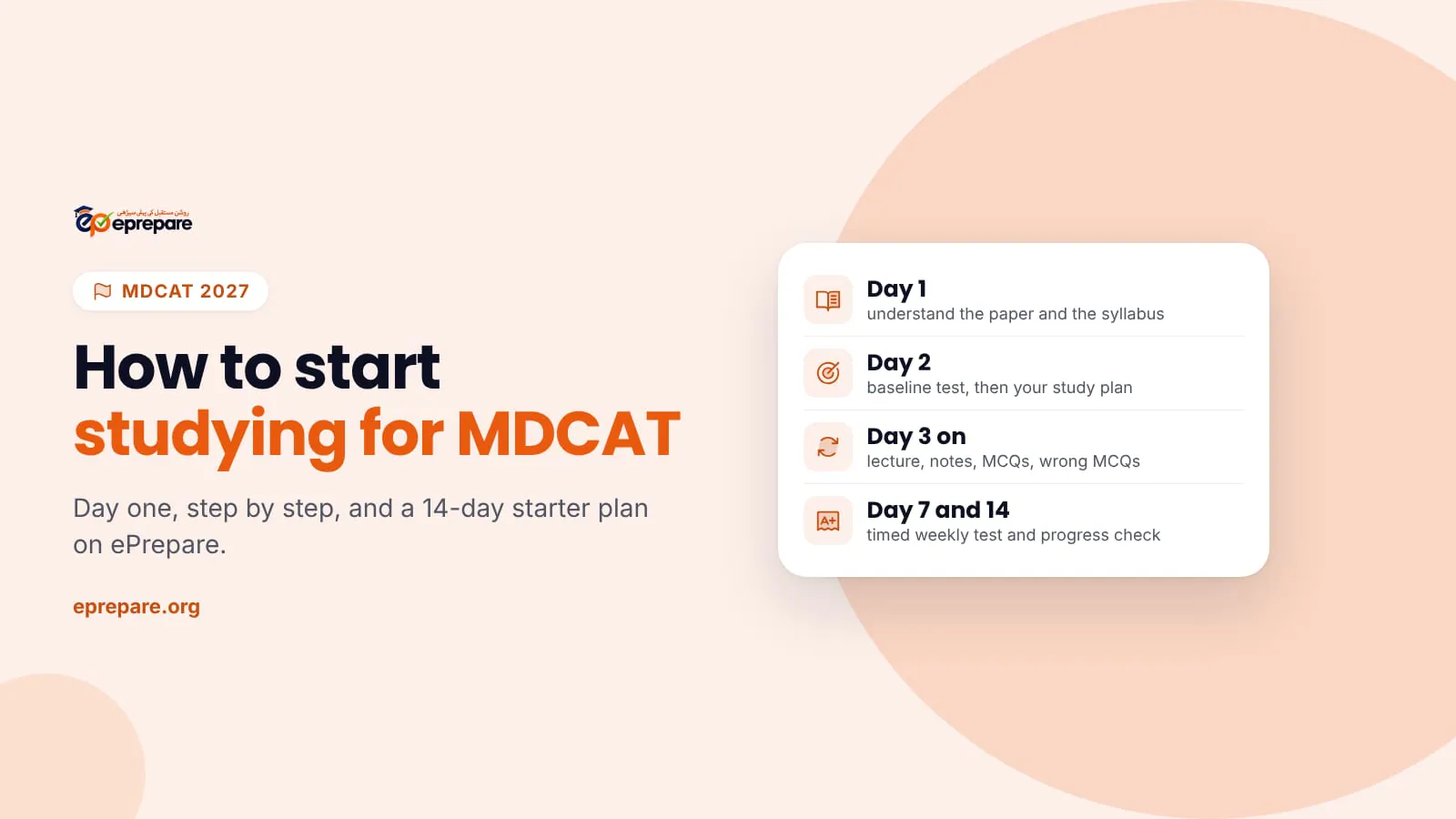
Students who qualify easily usually follow a plan with daily targets. Build one around the syllabus and your exam date with our MDCAT study plan guide, or follow the ready-made 90-day plan.
How ePrepare helps you qualify MDCAT
ePrepare is built around PMDC's MDCAT syllabus so you can prepare fully from home, at a fraction of an academy's fee.
- Chapter-wise and topic-wise MCQs for Biology, Chemistry, Physics, English and Logical Reasoning, each with a clear explanation.
- Bookline MCQs written line by line from the FSc textbooks, the way MDCAT Biology is asked.
- Conceptual notes for every unit, with easy Urdu boxes for hard ideas, diagrams and memory tricks.
- Full-length papers and past papers in the real 180-MCQ pattern, with your rank and a subject-wise report.
- Mistake Diary, smart revision and a predicted MDCAT score, so you always know what to fix next.
- A daily study plan and recorded lectures that keep you on track until test day.
Compare what each plan includes on the ePrepare packages page, or start with a free MDCAT online test to see where you stand today.
Frequently asked questions
How many marks are required to qualify MDCAT?
99 out of 180 (55%) for MBBS and 90 out of 180 (50%) for BDS.
Is 99 marks enough to get admission in MBBS?
No. 99 only qualifies you to apply. Public MBBS colleges in KPK and Punjab closed above 93% aggregate in 2025-26, which usually needs an MDCAT score well above 160 with strong FSc marks.
What is the minimum FSc percentage for MDCAT?
PMDC's 2026 regulations require at least 60% in FSc Pre-Medical or an equivalent qualification, unless PMDC notifies a higher figure. Check your admitting university's notice, as KMU has listed 65%.
Can I qualify MDCAT in my first attempt?
Yes. Most students who follow the PMDC syllabus, practise MCQs daily and take full-length tests qualify comfortably in their first attempt. Scoring high enough for a public seat takes more practice, which is what the tips above are for.
How long is the MDCAT result valid?
Three years, and it is valid for admission anywhere in Pakistan, whichever province you sat the test in.
Can I appear in MDCAT in another province?
No. PMDC allows candidates to sit MDCAT only in the province or region of their domicile, with Riyadh as the only international centre. The result is still valid nationwide.
Is there negative marking in MDCAT?
No. Wrong answers do not cut marks, so attempt every question.
Is there an age limit or attempt limit for MDCAT?
PMDC's 2026 regulations set no age limit and no limit on the number of MDCAT attempts.
Can A-Level students give MDCAT?
Yes. A-Level and other foreign 12th-grade students can sit MDCAT and apply for admission with an IBCC equivalence certificate showing at least 60% and the required subjects.
Is MDCAT needed to study MBBS abroad?
PMDC removed the MDCAT requirement for Pakistani students seeking admission to foreign medical and dental institutions in October 2026. MDCAT is still required for admission in Pakistan.
Is NUMS MDCAT different from PMDC MDCAT?
Yes. NUMS runs its own test for the armed forces medical and dental colleges, and that test counts only for those colleges.
How can I get high marks in MDCAT?
Study from the PMDC syllabus, give Biology the most time, read the textbook line by line, practise MCQs every day, keep a mistake list and take weekly full-length papers. ePrepare gives you all of these in one place.
Sources
- PMDC Admissions, Curriculum and Conduct Policy and Regulations 2026 (eligibility, merit formula, deadlines)
- Pakistan Medical and Dental Council Act 2022 (MDCAT validity)
- PMDC Uniform Curriculum MDCAT-2025 (pattern and pass marks)
- PMDC notice on MDCAT-2026 registration (domicile rule, centres)
- Punjab admission policy for MBBS and BDS, session 2026-27